


Amazon
Ads |


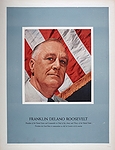
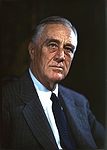
Franklin
Delano Roosevelt
32nd President of the United States of America
(1882–1945)
Positions Held
President of the United States of America 1933–45
Governor of New York 1929–33
Assistant Secretary of the Navy 1913–20
Senator from New York 1911–13
Congressional Medal of Honour (posthumous)
Biographical
Educated at Harvard University and Columbia Law School, and admitted to
the New York Bar in 1907,
Franklin Roosevelt was inspired by the political accomplishments of his
fifth cousin, President Theodore Roosevelt, whom he deeply admired, and
he entered politics as a Democrat. He was elected to the New York Senate
in 1910 and was appointed Assistant Secretary of the Navy by President
Wilson. In 1920, he was the Democratic candidate for Vice President. In
1921, at age 39, Roosevelt was diagnosed with poliomyelitis. Despite this
setback, he worked tirelessly to regain the use of his legs, notably through
swimming. At the 1924 Democratic Convention, he used crutches to nominate
Alfred E. Smith as 'the Happy Warrior'. Roosevelt was elected President
in November 1932. By March of the following year, the nation was grappling
with an unemployment crisis affecting thirteen million individuals, while
a significant portion of the banking system had collapsed. In response
to this economic catastrophe, Roosevelt proposed, and Congress enacted,
a sweeping programme designed to restore economic health to businesses
and agriculture, provide relief to the unemployed and those facing the
loss of their homes and farms, and implement fundamental reforms, most
notably through the creation of the Tennessee Valley Authority. Some recovery
was evident in 1935, but opposition to Roosevelt's New Deal grew among
businessmen and bankers. Concerns included his abandonment of the gold
standard, budget deficits, and labour concessions. In response, Roosevelt
implemented a new reform agenda featuring Social Security, increased taxes
on the wealthy, tighter controls on banks and public utilities, and an
extensive work relief program. Re-elected in 1936 with a significant margin,
Roosevelt attempted to expand the Supreme Court to counteract its rejection
of New Deal policies. Although he did not succeed in this effort, it led
to a shift in constitutional law that allowed for greater government regulation
of the economy. Roosevelt adopted a 'good neighbour' policy, revising
the Monroe Doctrine to encourage cooperative action against aggressors.
He also aimed to keep the U.S. neutral while aiding nations threatened
by aggression. After the fall of France and the siege of England in 1940,
he increased support to Great Britain, avoiding direct military involvement.
Following the Japanese attack on Pearl Harbor in December 1941, Roosevelt
organised the nation's resources and manpower for global conflict. Recognising
the importance of U.S.-Soviet relations for future global peace, he focused
on establishing the United Nations to address international disputes.
Roosevelt's health deteriorated towards the end of the war.
Place of birth: Hyde Park, New York
Place of marriage: New York City
Place of death: Warm Springs, Georgia
Place of burial: Hyde Park, New York
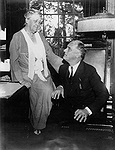
Son of James Roosevelt and Sarah Delano. He married Eleanor Roosevelt in
1905, and had issue.


© 2024 The Universal Compendium