Amazon Ads


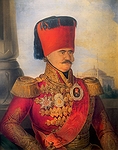
Milos Obrenović I
Prince of Serbia
(1780-1860)
Other names: Milos Teodorović Obrenović
Titles and Honours
Voivode of Rudnik, 1813-14
Highness, 1834
Supreme Leader of Serbia, 1817
Biographical
Founder of the Obrenović dynasty, Milos was born of poor Serbian
peasants. When he later became prince of Serbia he used to tell
how for a penny a day he drove cattle from Serbia to Dalmatia. His
half-brother, Milan Obrenović, who had developed into a successful
exporter of cattle and pigs into Austria, associated him in his own export
trade and otherwise supported him. Partly from gratitude and partly
because the family name of his half-brother was already honourably known
in the country, Milos adopted that name as his own, and called himself
Obrenović, instead of Teodorović. Karageorge, the leader
of the first Serbian revolution against the Turks, appointed Milos Obrenović
in 1807 a voivode, i.e. district commander of the national army and civil
administrator. As such he distinguished himself in many battles,
and was reputed a wise and energetic administrator and a just judge.
When in 1813 the Turks under the Grand Vizier Khurshid occupied Serbia,
and Karageorge and almost all his voivodes left the country for Austria,
Milos, although strongly advised to follow their example, refused to do
so. He remained in the country, surrendered to the Turks, and was
recognised by them as the voivode of Rudni. As he was then practically
the only chief of the nation, the Turks called him to Belgrade, where
he was kept through the year 1814 as a hostage. But he found means
to prepare a new rising of the Serbians against the Turks, and on Palm
Sunday 1815 he appeared with his voivode's standard before the people
round the small church of Takovo, and started the second and successful
insurrection. Not so much by his victories on the battlefields as
by his clever exploitation of the international difficulties of Turkey,
and of the known weakness of the Turkish pashas for 'baksheesh' (no doubt
also by his statesmanlike moderation), he succeeded in less than two years
in obtaining from the Porte the practical recognition of the Serbian people's
right to self-government. The National Assembly in 1817 elected
him prince of Serbia.
From that year began the organisation of Serbia by the Serbians as an
autonomous province of the Ottoman Empire. But its existence as
such rested on no safe and legal basis, except on the readiness of the
Serbians to defend it with all their might and on the goodwill of the
sultan and his 'Sublime Porte'. Milos therefore worked hard to obtain
some sort of international recognition of the semi-independent status
of Serbia. Russia came to his assistance, and by the Treaty of Adrianople
of 1829 the Porte engaged formally to grant Serbia full autonomy.
This engagement was somewhat developed in the Hatti-sherif of 1830, which
added to Serbia three districts (Krushevats, Alexinats, Zaechar), acknowledged
her full autonomy, recognized Milos as hereditary prince of Serbia, and
declared that the Turks in Serbia could have properties and live only
in fortified places where there were Turkish garrisons, and not in other
towns and villages. Milos won for his family the hereditary right
to the throne of Serbia without the co-operation of Russia. The
creation of a hereditary dynasty in Serbia was outside the Russian Balkan
policy of that time, and this great and independent success of Milos was
the first cause of Russia's dissatisfaction with him. The second
cause was that, yielding to the pressure exercised on him by his own people,
he gave the country a constitution without asking 'the protector of Serbia',
the tsar, for his approval of the step. The third cause was that
Milos consistently resented the interference of Russia in the internal
affairs of the principality. The climax of his misdeeds, from the
Russian point of view, was that on the occasion of his visit to the Sultan
Mahmud II. in 1836 he persuaded the British ambassador, Lord Ponsonby,
that it would be useful to establish a British consulate in Belgrade.
The first British consul in Serbia, Colonel Hodges, became speedily an
intimate friend of Prince Milos, who probably under his new friend's influence,
began to agitate to replace the exclusive protectorate of Russia by the
joint protectorate of all the great Powers of Europe. The cabinet
of St Petersburg now decided to remove Milos from the throne of Serbia,
and, supported by the Russian consul general, the leaders of the Serbian
opposition, who posed as champions of a constitutional system, succeeded
in forcing him to abdicate in 1839. After his abdication Milos lived
mostly on his estates in Romania, or in Vienna. In December 1858
the National Assembly of Serbia, having dethroned Prince Alexander Karageorgević,
recalled Milos to the throne of Serbia. Milos came, accompanied
by his son Mihailo, and began to reign in his own old fashion; but death
closed his activity on the 14th of September 1860. He was buried
in the cathedral of Belgrade.
Place of birth: Srednja Dobrinja
Place of death: Topcider, near Belgrade
 |
 |
Sources
1 . Encyclopaedia Britannica: A Dictionary of Arts, Sciences, Literature and General Information, 11th edn, vol. 18. New York: Encyclopaedia Britannica Co., 1911.
2. H. Montgomery-Massingberd, ed. Burke's Royal Families of the World. Volume I: Europe & Latin America. London: Burke’s Peerage Ltd., 1977.
3. Encyclopaedia Britannica. Chicago: Encyclopaedia Britannica, 2018. Chicago: Encyclopaedia Britannica, 2018.
4. Obrenovići. Patriot, 4 April 2018.
5. C.E. Bosworth, E. Van Donzel et al, eds. The Encyclopaedia of Islam, vol. IX, SAN - SZE. Leiden: Koninklijke Brill, 1997.
Families | Lands | Abbreviations and Symbols