
|
|
|
|||||||||
 |
||||||||||
| (216) | ||||||||||
| Milan
I
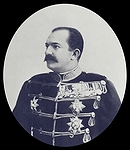
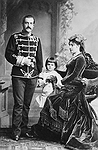
King of Serbia (1854–1901) Biographical Milan I, King of Serbia 1882–89 abd. Milan Obrenović IV, Prince of Serbia 1868–82 (under a Regency until 1872) Commander-in-Chief of the Serbian Army 1897 During the reign of his cousin Mihailo Obrenovic III, young Milan was educated in Paris at the Lycée Louis-le-Grand, where he demonstrated considerable intelligence. However, at the age of fourteen, in 1868, his cousin was assassinated, and Milan succeeded to the throne under a regency. By 1872, when he was declared of age, Milan took control of the government, showing remarkable intellectual ability alongside a passionate, headstrong character. Eugene Schuyler, who encountered him at this time, described him as 'a very remarkable young man...singularly intelligent and well-informed.' Through a careful balancing act between the Austrian and Russian factions in Serbia, and a strategic lean towards the Austrians, Milan was able, in 1878, to secure recognition of Serbia's independence from the Ottoman Empire following the Turkish War. He was proclaimed king in 1882. Under Austrian influence, King Milan devoted his efforts to improving communication infrastructure and developing Serbia’s natural resources, though the high costs, exacerbated by reckless extravagance, led to heavy taxation. This, alongside increased military service, made Milan and the Austrian-backed regime unpopular. His political troubles deepened with Serbia’s defeat in the 1885-86 war against Bulgaria. The union of Rumelia and Bulgaria in September 1885 sparked widespread agitation in Serbia, and Milan hastily declared war on his cousin, Prince Alexander, on 15 November. After a brief but decisive campaign, the Serbians were thoroughly defeated in the battles of Slivinska and Pirot, and Milan’s throne was saved only by Austria’s direct intervention. Domestic issues soon took on a political dimension. In October 1875, Milan married Natalie, the sixteen-year-old daughter of Peter Ivanovic Ketchko, a Moldavian Boyar, and the couple had a son, Alexander, in 1876. However, the marriage showed signs of discord, as Milan proved unfaithful, and Queen Natalie, influenced by Russian sympathies, found the couple ill-suited both personally and politically. In 1886, they separated, with Natalie taking their young son, Alexander, then aged ten, with her. While residing in Wiesbaden in 1888, Milan managed to reclaim the crown prince and sought to educate him. He pressured the metropolitan to obtain a divorce, which was later annulled as illegal. Milan seemed to have gained the upper hand, and on 3 January 1889, he promulgated a new, more liberal constitution than that of 1869. However, just two months later, on 6 March, he unexpectedly abdicated in favour of his son and settled privately in Paris. In February 1891, a radical ministry was formed, and with the return of Queen Natalie and ex-metropolitan Michael to Belgrade, Austrian influence waned while Russian influence grew. Fearing a revolution and Milan’s return, a compromise was struck in May 1891, resulting in Queen Natalie’s expulsion and Milan’s receiving a million francs from the civil list, on the condition he not return to Serbia during his son’s minority. In March 1892, Milan renounced all his rights and even his Serbian nationality. The situation changed in April 1893 when King Alexander, now of age, executed a coup d'état and assumed control of the government. Serbian politics grew more complex, with Russian intrigues becoming rife. Milan reappeared in Belgrade in January 1894, and his son, welcoming his father’s experience and counsel, reinstated him. On 29 April, a royal decree re-established Milan and Natalie as members of the royal family, and on 21 May, the constitution of 1869 was restored. Milan continued to exert significant influence over his son. Queen Natalie, who had largely resided in Biarritz, returned to Belgrade in May 1895 after a four-year absence, and was warmly received by the public. In 1897, Milan was appointed commander-in-chief of the Serbian army, where he achieved some of his most notable successes in reforming the military. His relationship with King Alexander remained cordial for a time, and it appeared that Russian influence had been countered. However, the father-son harmony was disrupted by the king’s marriage in July 1900, which Milan strongly opposed. Milan resigned from his military post and was subsequently banished from Serbia, after which the young king aligned himself with Russia. Milan retired to Vienna, where he died unexpectedly on 11 February 1901. While Milan was undoubtedly capable, he led a scandalously irregular life, devoid of moral principles. In examining his relationship with his son, it must be understood that, given Serbia’s dynastic and political context, Milan’s personal feelings were inevitably subordinated to political and strategic considerations. In 1897 Milan was appointed commander-in-chief of the Serbian army. In this capacity he did some of the best' work of his life, and his success in improving the Serbian military system was very marked. His relations with the young king also remained good, and for a time it seemed as though all Russian intrigues were being checked. The good relations between father and son were interrupted, however, by the latter's marriage in July 1900. Milan violently opposed the match, and resigned his post as commander-in-chief; and the young king banished him from Serbia and threw himself into the arms of Russia. Milan retired to Vienna, and there he died unexpectedly on the 11th of February 1901. Milan was an able, though headstrong man, but he lived a scandalously irregular life, and was devoid of moral principle. In considering his relations with his young son, it must be remembered that in the dynastic and political condition of Serbia natural feeling was inevitably subordinated in Milan to other considerations. Place of birth: Marasesci, Romania Place of marriage: Belgrade Place of death: Vienna Place of burial: Krušedol monastery Son of Milos Obrenović and Maria Catargiu, he was married to Natalija Keṣko in 1875 (divorced 1888) with issue. He also had illegitimate issue by Artemisia Hristić. |
||||||||||
| |
||||||||||


 |
||||||||||
| |
||||||||||
 |
||||||||||
|
||||||||||


