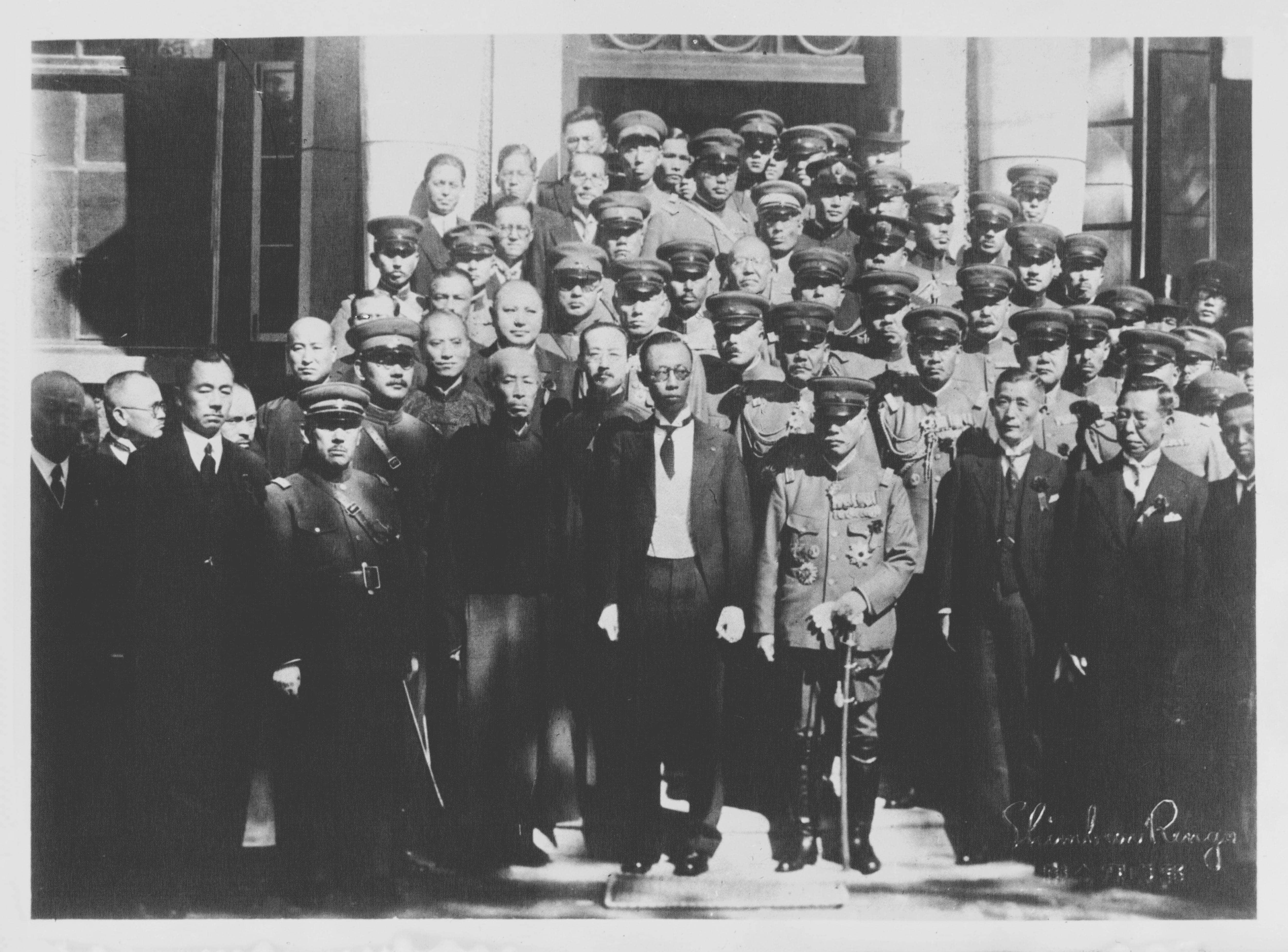
Puyi, the former Emperor
of China, alongside General Nobuyoshi Muto and Chang Hsiao-Hsu,
standing with a group after the signing of the Japan-Manchukuo
Protocol. Signed on 15 September 1932, this agreement secured
Japan’s official recognition of Manchukuo, the puppet state
established in north-eastern China following Japan’s invasion of
Manchuria. The protocol formalised Japan’s military and political
influence over the region, with Puyi serving as head of state under
close Japanese supervision. General Muto, a senior officer in the
Kwantung Army, played a key role in enforcing Japan’s control, while
Chang Hsiao-Hsu, a high-ranking official in Manchukuo’s government,
worked to legitimise the regime. The signing marked a critical step
in Japan’s broader expansionist ambitions in East Asia, further
escalating tensions in the region.