
|
|
|
|||||||||
 |
||||||||||
| (134) | ||||||||||
| Robert
de Hauteville
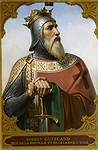
Duke of Apulia (1020–85) Other names: Robert Guiscard Biographical Duke of Sicily 1059–85† Duke of Calabria 1059–85† Count of Apulia 1056–85† A Norman adventurer, Robert settled in Apulia around 1047, eventually extending Norman rule over Naples, Calabria, and Sicily while laying the foundations of the Kingdom of Sicily. Born into a family of knights, he joined his half-brother Drogo in southern Italy, where he found regions plagued by political disturbances between Lombards, Byzantines, and other powers. Between 1047 and 1049, he was betrothed to the daughter of Prince Pandulf IV of Capua, but Pandulf broke off the arrangement. Robert held command of the garrison at Scribia near Cosenza under his brother Drogo in 1049 and was then sent to Calabria to attack Byzantine territory through pillaging and ransoming, earning him the nickname of 'Guiscard'. In 1053, he led combined Norman forces to victory against Byzantines, Lombards, and papal forces at Civitate. After his brothers' deaths, he returned to Apulia to seize control and prevent internal conflicts from tearing the region apart. His brother Humphrey granted him the region of Calabria and appointed him guardian to his son, Abelard, in 1056. After Humphrey died that same year, Robert seized his lands. He repudiated his first wife, Alberada, for reasons of consanguinity but, in reality, to secure a more illustrious marriage with his second wife. Robert emerged as a shrewd political figure who, in 1059, entered into a concordat at Melfi with Pope Nicholas II, transforming the papacy from hostile to supportive by promising to expel the Arabs from Sicily and restore Christianity, leading to the 1060 Sicilian expedition commanded by his brother Roger under Robert's supreme authority. He captured Reggio and Cosenza in 1060, and conquered Calabria He expanded his duchy from the Adriatic to the Tyrrhenian Sea, captured Bari in 1071 ending Byzantine rule in southern Italy, and through strategic alliances, eventually conquered Salerno in 1076 making it his capital. However, Pope Gregory VII excommunicated Robert in 1075 and 1078 because his Norman advances into Campania, Molise, and Abruzzi threatened the papal dominions. By 1080, he made peace with the Pope, and pledged his loyalty and allegiance to him. As the pope’s champion Robert, along with his brother Roger, waged incessant war against the Greeks and Saracens in southern Italy and Sicily and fought against the Byzantine emperor, Alexius Comnenus, gaining a great victory over him at Durazzo in 1081. Robert pursued ambitious Byzantine campaigns with the goal of marching to Byzantium and crowning himself emperor in place of the deposed Michael VII, landing in Epirus in 1083, where he defeated Byzantine and Venetian forces. Upon learning that Emperor Henry IV had invaded Italy, Robert hastened back, compelled Henry to retreat, and liberated the pope, who was besieged at the castle of St. Angelo in 1084. He then returned to Epirus, repeatedly defeated the Greeks, and was on his way to Constantinople when he died suddenly. Physically attractive and endowed with acute intelligence, Robert was a brilliant strategist who organised a state composed of diverse ethnic groups using a monarchical-feudal framework controlled by his ducal power, building upon Latin Christianity as a unifying force while generously endowing the Latin Church with territories and immunities. He constructed splendid cathedrals and Benedictine abbeys to consolidate Latin language and culture among his heterogeneous subjects. Place of birth: near Countances, Normandy Place of death: Phiscardo Bay, Cephalonia Place of burial: Monastery of Santissima Trinità, Venosa Son of Tancred de Hauteville and Fressenda N, he was married firstly to Alberada di Buonalbergo in 1051 (divorced 1058), with issue, and secondly to Sichelgaita of Salerno in 1059, with issue. |
||||||||||
| |
||||||||||
  |
||||||||||
| |
||||||||||
 |
||||||||||


