
|
|
|
|||||||||
 |
||||||||||
| (12) | ||||||||||
| Leonor
de Toledo
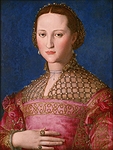
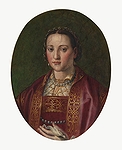
(1522–62) Biographical Leonora de Toledo arrived in Naples in 1534 with her mother and sister, joining the vice-regal court where her father served as viceroy. There she received her education and immersed herself in the vice-regal court, where she formed close relationships, including with her Jewish mistress, Bienvenida Abravanel, whose family she later supported in Florence. Her 1539 marriage to Cosimo de’ Medici, 2nd Duke of Florence, solidified an alliance between Naples and Florence, securing Cosimo’s rule in Tuscany and aligning the duchy with Spanish imperial power. Upon her arrival in Florence, Leonora brought an elaborate entourage, marking the beginning of her influential role as duchess. She actively participated in governance, serving as regent during Cosimo’s absences and managing critical affairs such as grain shortages, military campaigns, and financial acquisitions. Her cultural patronage and strategic acumen elevated the Medici dynasty, as she facilitated Spanish alliances, supported religious and educational initiatives, and commissioned significant works of art and architecture, including the expansion of the Palazzo Pitti. Leonora’s court retained a strong Spanish presence, reflecting her heritage, and her patronage extended to literature, the arts, and religious orders, including the Jesuits. Her conscious approach to patronage as a duty of governance was evident in her support for the reopening of the University of Pisa and the founding of the Accademia degli Elevati. Despite poor health exacerbated by tuberculosis and frequent childbirth, Leonora maintained her role as a central figure in the Medici court until her death in 1562, shortly after a tragic bout of malaria claimed two of her sons. She was celebrated posthumously through literary and artistic tributes, her legacy cemented as a symbol of Medici power and influence. The duchess’s achievements in governance, cultural patronage, and dynastic strategy continued to leave an enduring impact under the reigns of her sons Francesco I and Ferdinando I, who preserved and expanded the Medici-Toledo alliance. Place of birth: Villafranca del Bierzo? Place of marriage: Florence Place of death: Pisa Place of burial: Basílica of San Lorenzo, Florence Daughter of Pedro Álvarez de Toledo and María Osorio, she married Cosimo de' Medici in 1539, and had issue. |
||||||||||
 |
||||||||||
 |
||||||||||
|
||||||||||


