
|
|
|
|||||||||
 |
||||||||||
| (12) | ||||||||||
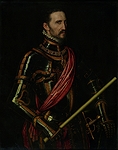
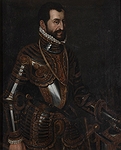
| Fernando
Álvarez
de Toledo
3rd Duque de Alba de Tormes (1507–82) Other names: El Grand Duque de Alba Biographical 3rd Duque de Alba de Tormes, Grandee of Spain 1531–82† 4th Marqués de Coria 1510; †1582 3rd Conde de Salvatierra de Tormes 1531–82† 2nd Conde de Piedrahita 1531–82† Conde del Barco 1531–82† 7th Señor de Valdecorneja 1531–82† 4th Señor de Huéscar 1513–31† Knight of the Order of the Golden Fleece 1546 [Burgundian] 11th Viceroy of Naples 1556–58 Governor of the Low Countries 1567–73 res. Governor of Milan Captain general of Naples 1556 State councillor 1543 Grand Steward to the King Fernando’s grandfather, the third Duke of Fernando, educated him in military science and politics. He distinguished himself at the Battle of Pavia in 1525 while still a youth. Selected for a military command by Charles V, he participated in the siege of Tunis in 1535 and successfully defended Perpignan against the dauphin of France. He was present at the Battle of Mühlberg in 1547, where the victory over John of Saxony was largely due to his efforts. He later took part in the siege of Wittenberg and presided over the court-martial that condemned the Elector to death. In 1552, Fernando commanded the army tasked with invading France and spent several months unsuccessfully besieging Metz. After French successes in Piedmont, he was appointed commander-in-chief of the emperor’s forces in Italy, with unlimited power. Despite his initial failures and forced retreat into winter quarters, Charles V’s abdication did not end his career, as Philip II retained him in command. However, Philip restrained Fernando from extreme measures, even when Fernando had subdued the Campagna and reached the gates of Rome. Philip compelled him to negotiate peace, including a humiliating condition that Fernando personally seek forgiveness from the Pope. Although proud by nature, Fernando later confessed that his voice faltered and he lost his composure during the meeting. In 1559, Fernando led a grand embassy to Paris to arrange the marriage of Philip II to Elizabeth, daughter of Henry II of France. In 1567, Philip, a staunch Catholic, sent Fernando to the Netherlands with an army of 10,000 men and absolute authority to suppress heresy. Upon arrival, Fernando established the infamous ‘Court of Blood’, which persecuted those involved in the recent unrest provoked by Philip’s oppressive policies. He imprisoned and executed the Protestant leaders Egmont and Horn, annihilated civic privileges, and executed thousands. He erected citadels in major towns and a statue in Antwerp depicting himself trampling the estates of the Low Countries, symbolising both his tyranny and vanity. Fernando’s attempt to impose the Spanish alcabala, a 5% tax on all sales, provoked resistance even from Catholic regions. Exiles from the Low Countries organised a fleet of privateers, capturing the town of Brielle and inspiring widespread rebellion. The States-General at Dordrecht declared against Fernando, rallying under the Prince of Orange. Though Fernando initially recaptured several towns and achieved victories through his son, Frederick, resistance in Holland and Zeeland persisted. After the brutal sack of Naarden and a costly siege of Haarlem, his forces were repulsed at Alkmaar, forcing him to retreat. Worn down by ill health and continued setbacks, he sought to resign, a request Philip likely welcomed. In December 1573, Fernando departed the Netherlands, boasting infamously that he had executed 18,000 people in six years, excluding those killed in battle or massacres. Upon his return, Philip initially treated him with honour, but later banished him to the castle of Uzeda due to his son’s disgraceful conduct. Two years later, with Don Antonio challenging Philip for the Portuguese throne, Fernando’s military expertise was again required. Despite his age, he zealously accepted the command. In 1581, Fernando invaded Portugal, defeated Don Antonio, and brought the kingdom under Philip’s control. After seizing a vast treasure in Lisbon, his soldiers plundered the city’s suburbs with characteristic violence. When asked to account for the campaign’s expenses, Fernando reportedly replied, 'If the king asks for an account, I will provide one of kingdoms preserved, battles won, and sixty years of service.' Philip pursued the matter no further. Fernando’s triumph in Portugal marked his final campaign. He died at the age of 74, his long career characterised by military brilliance, cruelty, and enduring loyalty to his monarch. Place of birth: Piedrahita Place of death: Lisbon Son of García Álvarez de Toledo and Beatriz Pimentel, he married María Enríquez de Guzmán in 1529, and had issue: • García (see) • Fadrique (see) • Diego (see) • Beatriz, married firstly to Álvar Pérez Osorio, and secondly to Lorenzo Suárez de Figueroa in 1581, with issue • María Fernando also had illegitimate issue: • Fernando (see) |
||||||||||
 |
||||||||||
 |
||||||||||


