
|
|
|
|||||||||
 |
||||||||||
| (12) | ||||||||||
|
Fadrique
Álvarez de Toledo
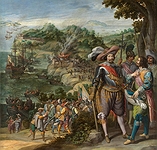
1st Marqués de Villanueva de Valdueza (–1634) Biographical 1st Marqués de Villanueva de Valdueza 1624–34† Captain General of the Armada of the Sea 1618 Admiral Commander del Valdericote in the Order of Santiago Chief commander of Castile Fadrique followed the path laid by prominent Spanish naval figures such as Admirals Bazán, Fajardo, Esquivel, Vizcaíno, Fernández Quirós, and Váez de Torres, recognising the importance of naval strength in defending Spain’s interests. He opposed Turkish expansion and the persistent attacks from Berber pirate corsairs and the Dutch navy, who were especially focused on seizing Brazil, formerly a Portuguese colony and part of the Spanish Crown since the death of King Sebastián I of Portugal. In the Mediterranean, his forces combated Turkish and Berber pirates, who operated from Algiers and ravaged Spanish coastal towns. Spanish-controlled regions, including the Catalan and Valencian coasts, lobbied for regional fleets to protect their shores from such attacks. His naval career saw several key victories, most notably in 1621 at Cape St. Vincent, where he triumphed over a superior Dutch fleet, capturing three enemy ships, sinking two, and setting a third on fire. In 1623, he defeated a Moroccan fleet in the Strait of Gibraltar and gained further fame in 1625, when he led a successful campaign to expel the Dutch from Brazilian territories. The Dutch had established a foothold in Brazil due to its lucrative trade, including salt from Venezuela’s Araya coast and valuable resources like pearls and sugar. Fadrique’s forces recaptured Bahia, taking thousands of prisoners and large quantities of military equipment, although the Dutch regained control over much of the region until 1654. Despite his success, Fadrique’s rise provoked the jealousy of the powerful Gaspar de Guzmán, the Count-Duke of Olivares, who ordered him back to Brazil in 1634 to combat the Dutch again. His declining health, caused by years of military service, led Fadrique to request exemption from the mission, but Olivares refused, leading to a bitter confrontation. Olivares’ decision to imprison Fadrique, impose a hefty fine, and exile him for ten years marked the end of Fadrique’s career. This unjust treatment led to his death. Fadrique’s legacy was posthumously recognised, as were those of his father and son, both prominent figures in Spain’s naval history. Place of birth: Madrid Son of Pedro Álvarez de Toledo and Elvira de Mendoza, he married his niece, Elvira Ponce de León, and had issue: • Fadrique (see) • Victoria, †1655, married to Francisco Ponce de León Fadrique also had illegitimate issue: • Iñigo (see) |
||||||||||
 |
||||||||||
 |
||||||||||


