
|
|
|
|||||||||
 |
||||||||||
| (12) | ||||||||||
| Antonio
Sebastián
de Toledo Molina
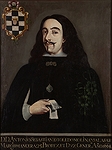
2nd Marqués de Mancera (1620–1715) Biographical 2nd Marqués de Mancera 1654–1715†, Grandee of Spain 1692 (personal 1686) 4th Señor de El Mármol 7th Señor de Mancera 7th Señor de las Cinco Villas Señor de Naharros del Castillo Señor de Montalvo Señor de Salmoral Señor de Gallegos de Solmirón Señor de San Miguel de Serrezuela Viceroy of New Spain 1664–74 Governor of New Spain 1664–74 Knight of the Order of Alcántara [Spain] State councillor 1691 Commander of Puertollano in the Order of Calatrava Commander of Alcántara Governor of Milan High Steward to Queen Mariana of Austria Governor of the Stables to Carlos II General Treasurer of the Order of Alcántara Captain General of the Armada in Peru Infantry captain Perpetual Alférez Mayor of Úbeda Member of the Council for War Ambassador to Germany Ambassador to Venice Antonio travelled to Peru in 1639, accompanying his father, who had been appointed viceroy. A distinguished sailor, he became general of galleys in Peru and captain general of the Armada del Mar Océano. He led an expedition to refound Valdivia, a city previously destroyed by Dutch incursions. Departing from Callao in December 1644, the expedition successfully rebuilt the city by February 1645, placing it under the administrative control of the Peruvian viceroy. During the same period, fortifications of the bay began, including the construction of the San Pedro de Alcántara fort on Mancera Island, as well as other forts and defensive works. These efforts, designed to curb enemy advances from the South Pacific, extended throughout the region. After leaving Peru with his father in 1650, Antonio returned to Spain, where he served in the court of Queen Mariana of Austria. His career flourished through various diplomatic positions. In 1664, he was appointed viceroy of New Spain by Philip IV, despite opposition from the Council of the Indies, which doubted his fitness due to his fragile health. He arrived in Veracruz in mid-1664 and took office in Mexico City in October, inheriting a tense atmosphere from his predecessor. The administration had been marked by public dissatisfaction and unrest, which he sought to address by curbing unnecessary expenditures and reinforcing the country's defences. Rather than hosting a lavish reception, Antonio focused on the immediate needs of the viceroyalty, especially the repair and fortification of strategic locations. The pirate threat, particularly from English, French, and Dutch corsairs, was one of the major challenges, with frequent attacks on New Spain's Caribbean and coastal territories. He took significant measures to strengthen defences, notably through military campaigns and fortification projects across the region, including in Acapulco, Veracruz, Yucatán, La Habana, Santo Domingo, Puerto Rico, and San Juan de Ulúa. Among these efforts was the construction of the Media Luna at the San Juan de Ulúa fortress in Veracruz, a complex and slow process due to the need for stone from Campeche. The viceroy also prioritised the continuation of Mexico City’s drainage system, a critical infrastructure project that had begun in 1607. Though it had been neglected in the years before his tenure, Antonio revived the efforts in 1665, naming a new superintendent, fray Juan de Cabrera, to oversee the works. Under his direction, significant progress was made to alleviate flooding, a persistent issue in Mexico City due to its location in a former lakebed, and was a vital improvement to the city's infrastructure. Additionally, Antonio focused on the maintenance of the capital's sanitation, cleaning the city's ditches and repairing its roads, which contributed to the overall improvement of public health and hygiene. He also took steps to ensure the proper functioning of the silver trade by combatting fraud and establishing new royal mints, such as in Guanajuato in 1665 and Pachuca in 1667, which boosted tax revenues. At the same time, he fought corruption among colonial officials and took a conciliatory approach to tensions between peninsular Spaniards and Creoles. His governance was marked by a mix of administrative reform and practical infrastructure improvements, ensuring that vital sectors such as mining, trade, and defence were strengthened, even amidst the region's frequent external threats. In 1673, after nearly eight years in office, Antonio requested a replacement and left New Spain. His wife, Leonor, died during the journey back to Spain in the following year. He remarried after returning to Spain and became involved in court politics, supporting Queen Mariana and playing an active role in Spanish state affairs. Throughout his career, Antonio's focus on infrastructure, defence, and administration left a lasting impact on New Spain, reinforcing both its military and economic stability. Place of birth: Madrid Place of death: Madrid Son of Pedro Álvarez de Toledo and María Salazar, he was married firstly to Leonor Carreto in 1655, with issue: • María Luisa (see) Antonio was married secondly to Juliana de Meneses. |
||||||||||
 |
||||||||||
 |
||||||||||


