|


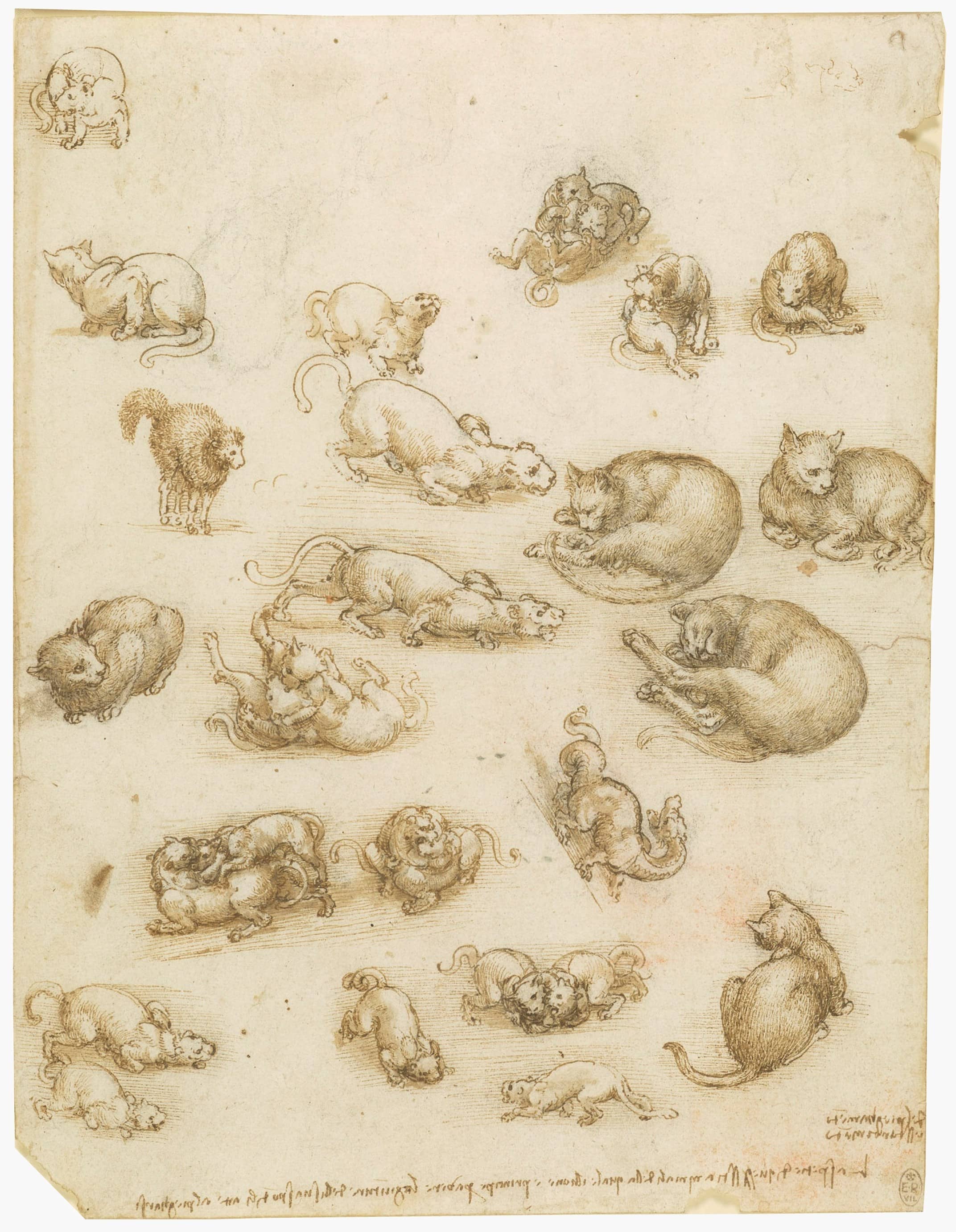
Studies
of cats, lions and a dragon
Black chalk, pen and ink, wash, 27 x 21 cm, by Leonardo da Vinci, c.
1513–18
Royal Collection Trust, London
This sheet by presents a detailed exploration of feline anatomy and
movement. Over twenty drawings depict domestic cats and a lioness in a
wide range of poses. From peaceful sleep and playful interactions to
fierce fights and startled reactions, the cats display the full spectrum
of feline behaviours. A single lioness, primarily crouched or prowling,
adds a majestic counterpoint to the domestic scenes. While a fantastical
dragon, drawn at an unusual angle, injects a touch of the unreal, it
also serves as a testament to da Vinci's boundless imagination. The
studies of sleeping cats, particularly in the centre right, suggest
meticulous observation from life, with the subjects rendered in a state
of perfect stillness. Conversely, the depictions of fighting felines,
where it's often difficult to distinguish individual limbs, demonstrate
da Vinci's reliance on fleeting impressions captured in a split second.
Seven surrounding drawings of the lioness show a clear understanding of
its anatomy and proportions, likely informed by live specimens kept in
Florence at the time. However, the unifying theme of the sheet is
revealed by a short, unfinished note by Leonardo himself: 'Of flexion
and extension... This animal species, of which the lion is the prince
because of its spinal column which is flexible...' This aligns with a
similar note on a separate animal study sheet and a memorandum in one of
his manuscripts, both referencing the 'serpent-like movement' as a key
principle in animal locomotion. These notes, coupled with Leonardo's
expressed intention to write a treatise on the subject, solidify his
primary focus – to capture the remarkable variety of positions and
movements achievable by members of the cat family. The inclusion of the
dragon underscores this aim, pushing the boundaries of anatomical
accuracy into the realm of pure imagination. While the treatise on
animal movement ultimately remained unrealised, this sheet stands as a
testament to Leonardo's insatiable curiosity and his enduring
fascination with the feline form.
|
|
|
Provenance
 Francesco
Melzi Francesco
Melzi
Pompeo
Leoni, c. 1582-90
Thomas
Howard, 14th Earl of Arundel, by 1630
Probably
Charles II, King of Great Britain
Royal
Collection, by 1690
Source: The Royal Collection, 2023.
|