
|
|
|
|||||||||
 |
||||||||||
| Horace Vernet (1789–1863) | ||||||||||
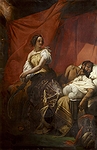
| Born in Paris, Vernet was a history and genre painter. He studied under his father, the painter Carle Vernet, and also under François-André Vincent. At the age of fifteen, he supported himself through his drawings. In 1810, he exhibited The Capture of a Redoubt, in which he abandoned the classical style of David and began to represent nature with greater truth. In 1812, he won a first-class medal for The Taking of an Entrenched Camp, a work that lacked depth in observation but was distinguished by considerable character. In 1826, he became a member of the Institute, and from 1828 to 1839, he served as the director of the French Academy in Rome. Vernet painted military, oriental, and biblical scenes with success, but after 1836, he focused primarily on battle scenes and depictions of Arab life in Algeria. With remarkable facility for invention and execution, he never achieved either the beauty of colour or the dignity of line. Nevertheless, he is regarded as one of the great French painters for his contribution to the shift from pseudo-classicism to the observation and close study of nature that characterised the modern schools. Vernet died in his native city of Paris. | ||||||||||
| |
||||||||||

 |
||||||||||
|
|
||||||||||
| |
||||||||||
  |
||||||||||


 Art
Art