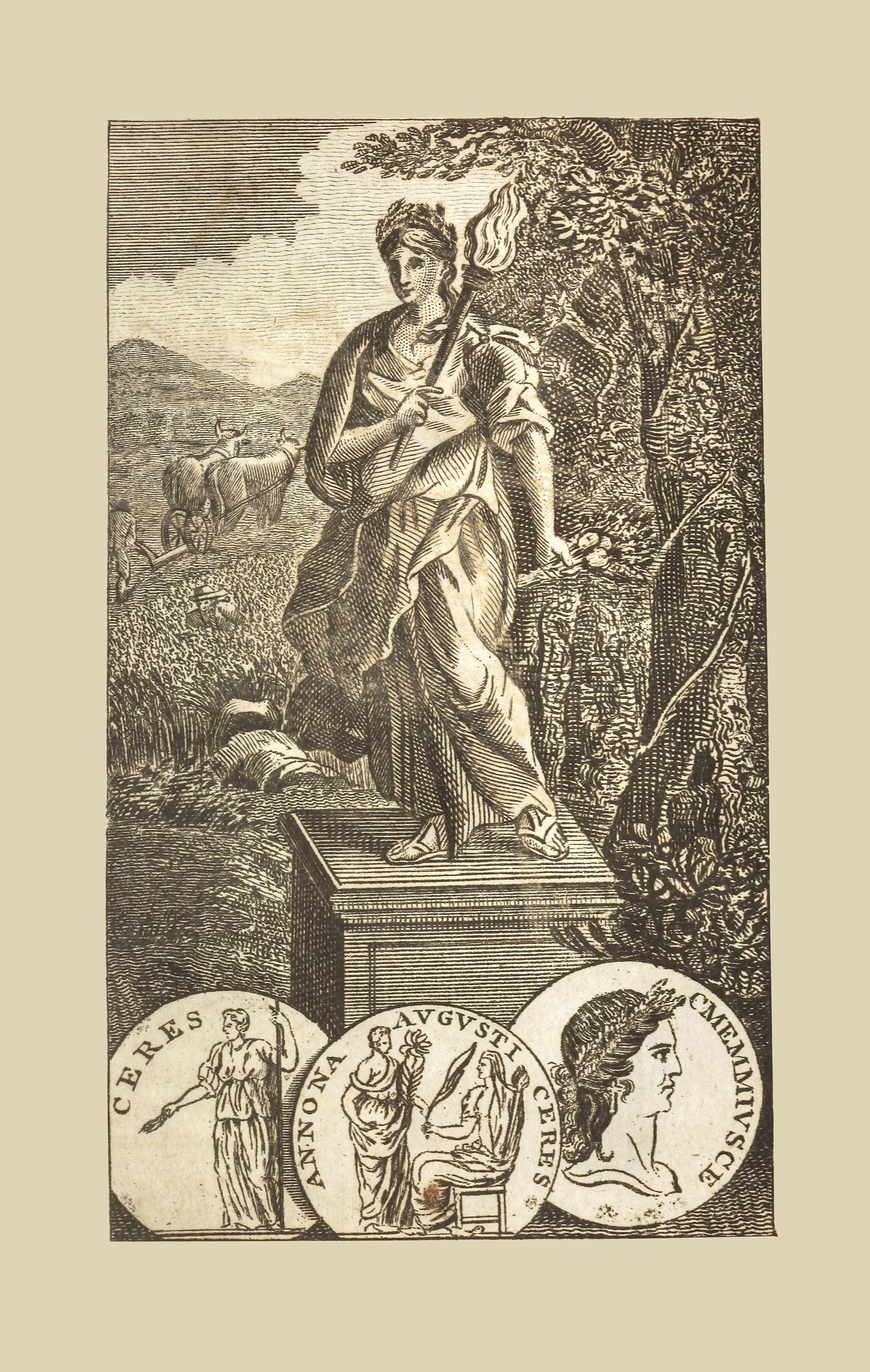
Ceres is portrayed as a
serene yet commanding presence, standing atop a stone pedestal in
the midst of a fertile, rural landscape. She is draped in classical
robes that fall in soft, careful folds, suggesting both dignity and
natural grace. In her right hand, she holds a lit torch, a symbol
often associated with her relentless search for her daughter
Proserpina, but also carrying connotations of illumination and
guidance. Her left arm holds a sheaf of wheat, clearly emphasising
her role as the goddess of agriculture, grain, and the sustaining
power of the earth. The background scene enhances her agricultural
domain: fields of wheat sway under a gentle sky, and an ox plods
steadily in the distance, yoked to a plough. The inclusion of this
hardworking detail roots the image not in divine abstraction, but in
the tangible world of human labour and seasonal cycles. Beneath the
figure, three large coins are carefully arranged. Each functions
almost like a historical or numismatic reference. The first bears
the name 'Ceres' and shows her receiving or offering grain,
reinforcing the idea of reciprocal generosity between deity and
devotee. The central coin reads ANNONA AVGVSTI CERES ('the grain
supply of Augustus, Ceres'), referring to the grain provision and
agricultural prosperity under the Emperor, symbolised by Ceres. The
final coin, marked 'C. Memmius C.f.', shows a profile of the praetor
Gaius Memmius (d. c. 49 BC).