
|
|
|
|||||||||
 |
||||||||||
| Henry Raeburn (1756–1823) | ||||||||||
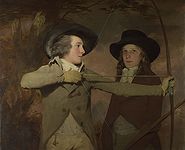
| Sir Henry Raeburn, born in Stockbridge near Edinburgh, rose from modest beginnings to become Scotland’s most renowned portrait painter. Orphaned at six, he was educated at Heriot’s Hospital before being apprenticed at fifteen to the goldsmith Mr Gilliland, whose friend, the etcher David Deuchar, noticed Raeburn’s talent and offered early guidance. Gilliland introduced him to David Martin, a former pupil of Allan Ramsay, who allowed Raeburn to copy some of his works, though their association ended acrimoniously. Encouraged by his master, Raeburn turned to portraiture professionally, first in miniatures before swiftly moving to oils, his technical ability already striking by age twenty. In 1778, he married a wealthy widow, which gave him financial stability, and in 1785 he travelled to London, meeting Sir Joshua Reynolds who advised and assisted him, urging a study trip to Rome. There, Raeburn deepened his understanding of art through contact with Gavin Hamilton and James Byres, the latter influencing his insistence on painting from life. His approach—working directly with brush on canvas without preparatory drawings or a mahl-stick—was already developed before Italy but matured there. Back in Edinburgh by 1787, Raeburn’s reputation soared; he painted over a thousand life-size portraits, rarely using assistants or taking pupils, though figures like Sir J. Watson Gordon benefited from his advice. Elected to the Royal Academy by 1815, knighted in 1822, and appointed His Majesty’s Limner for Scotland in 1823, Raeburn worked in his custom-built studio in York Place until his death that same year. His direct, powerful technique and keen perception of character shaped Scottish portraiture and earned him lasting acclaim, particularly after the 1877 Burlington House exhibition brought wider recognition beyond Scotland. | ||||||||||
. |
||||||||||
| |
||||||||||
 
 |
||||||||||
| |
||||||||||
  |
||||||||||


 Art
Art