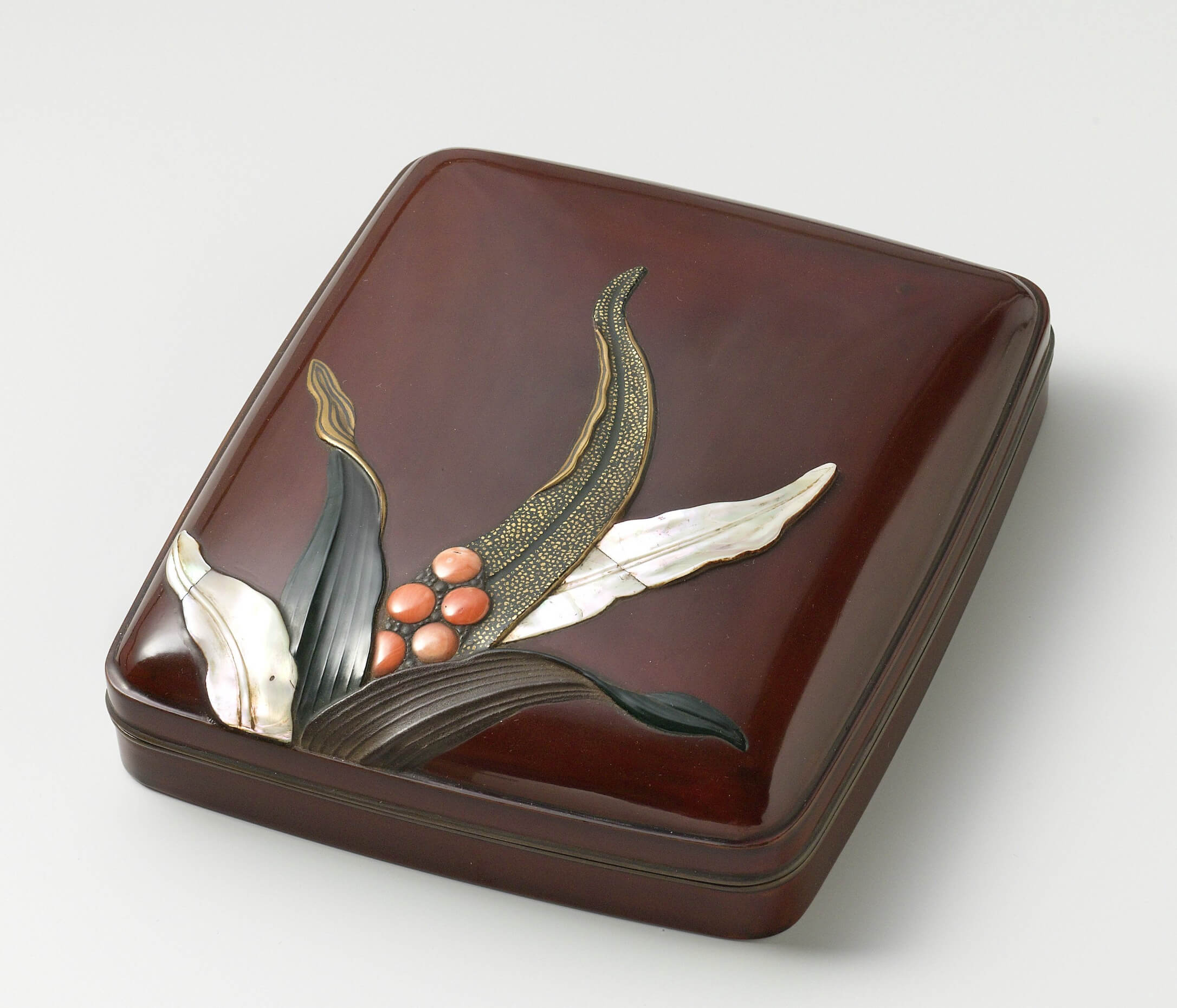
A red-brown lacquer covers the surface of this suzuribako, its rich,
polished finish lending warmth and depth to the entire piece. This
lustrous coating serves as the backdrop for a detailed motif of
Rohdea japonica, known in Japanese as omoto, a plant associated with
resilience and longevity. The leaves sweep across the lid in an
elegant arrangement, some rendered in dark lacquer, others in
iridescent mother-of-pearl, catching the light with shifting tones
of green, white, and pink. One leaf is highlighted with gold powder
in the makie technique, its fine shimmer adding delicate contrast to
the surrounding shell and lacquer. Clustered near the centre, small
coral berries introduce a soft, organic texture, their red-orange
hue harmonising with the warmth of the lacquered surface. The
composition is both intricate and balanced, with the interplay of
materials—shell, coral, lacquer, and gold—enhanced by the soft gleam
of the red-brown finish, which unifies the work and enhances its
refined, tactile beauty. The techniques and materials used,
particularly the makie decoration, reflect the craftsmanship and
aesthetic associated with lacquerware of the Edo period.