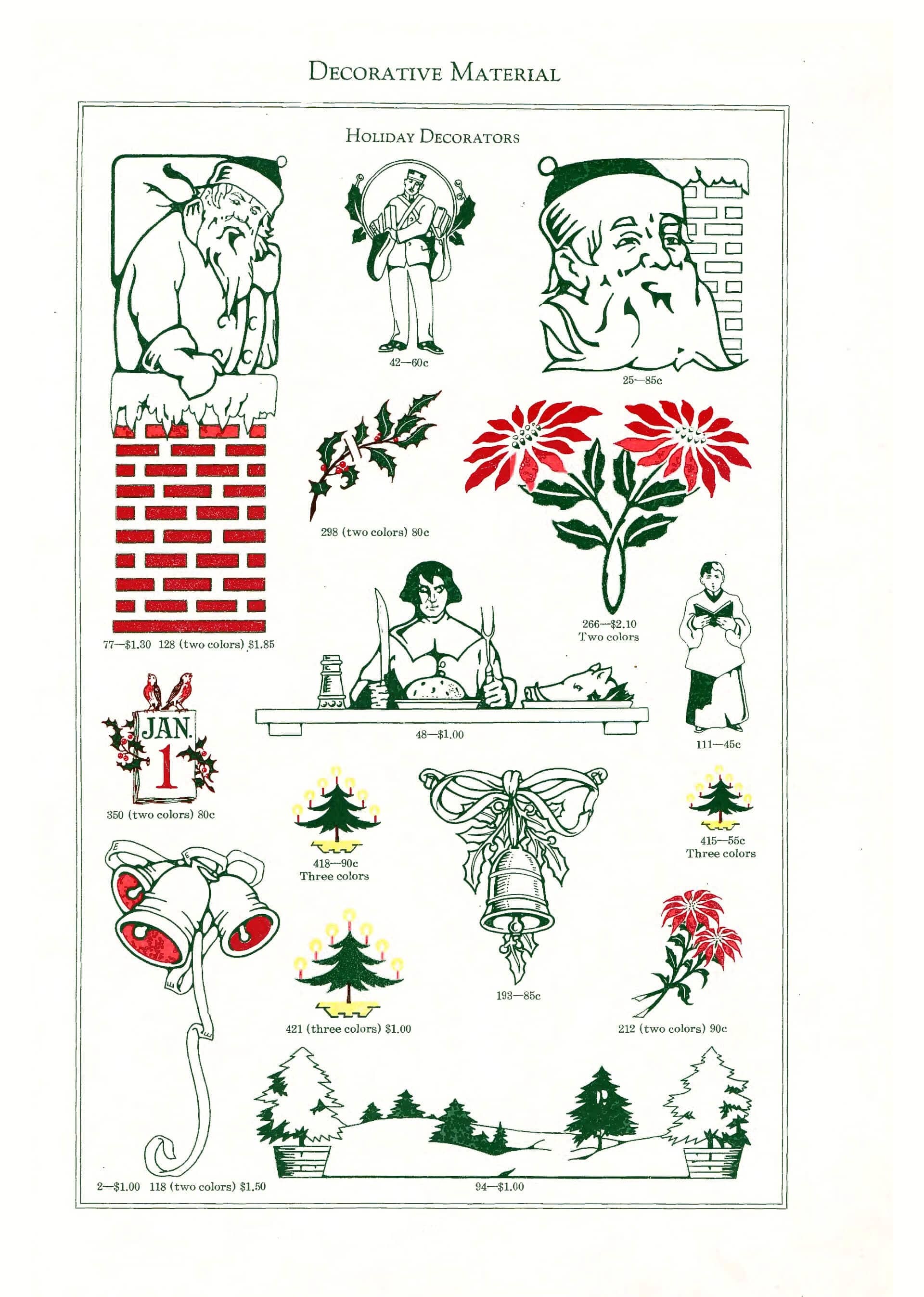
Printer’s ornaments were
decorative elements used throughout the letterpress printing trade,
featured prominently in type specimen books and widely employed in
both commercial and book printing. These ornaments included borders,
flourishes, corner pieces, rules, vignettes, and also decorative
lettering—such as illuminated initials, monograms, and stylised
title treatments. They were used to embellish a variety of printed
materials, including advertisements, packaging, greeting cards,
business cards, invitations, and also title pages, chapter openings,
and colophons in books. Initially printed in black and white,
coloured ornaments became more widespread as printing technology
advanced, particularly with improvements in registration and
multi-colour presswork. By 1923, the visual style of these designs
was in transition: while many retained the detailed, organic forms
of the Victorian and Art Nouveau eras, others began to reflect the
emerging Art Deco taste for symmetry, stylisation, and geometric
form. Often cast in metal and printed with precision, printer’s
ornaments were both functional and expressive, contributing to the
overall design and tone of a printed work.