
|
|
|
|||||||||
 |
||||||||||
| Jean-Léon Gérôme (1824–1904) | ||||||||||
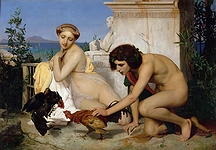
| Born in Vesoul, Haute-Saône, Gérôme was a French painter and sculptor, known for his academic style and as one of the leading artists of the nineteenth and early twentieth centuries. His journey into the art world began when a copy he made of a painting by Decamps was seen by a friend of Paul Delaroche, which led to Gérôme joining Delaroche's studio in Paris in 1841. He traveled with Delaroche to Italy in 1844 and 1845, and then to Rome in 1848. Apart from a brief stint with Gleyre, Gérôme's early training was entirely under Delaroche. He assisted Delaroche on The Passage of the Alps by Charlemagne. Although he failed to win the Prix de Rome in 1847, his painting The Cockfight exhibited at the Salon that year caused a sensation. Over the years, he continued to exhibit his works and earned medals in 1847, 1848, and 1855. In 1854, Gérôme traveled to the Danube provinces and spent several years in the East, which provided him with a wealth of subject matter for his paintings. His reputation grew significantly after the 1857 Salon, where he presented a series of more popular works. In 1859, Gérôme attempted a return to a more classical style with Caesar, but the painting did not capture the public’s interest. Some of his works, such as Le Roi Candaule, caused scandals because of their provocative subject matter, earning sharp criticism from critics such as Paul de Saint-Victor and Maxime Ducamp. In 1863, Gérôme became a professor at the School of Fine Arts, and over time, he became known for his paintings of ancient life, leading a school of art later known as the Pompeiian or New Greek style. In 1865, he was appointed as a professor of painting at the École des Beaux-Arts and won a medal of honour at the Universal Exposition of 1867. His reputation as a sculptor grew after his debut at the 1878 Universal Exposition in Paris, where he was recognised as a leading sculptor. Gérôme died in Paris in 1904, with his later works more strongly represented in sculpture. | ||||||||||
| |
||||||||||
 |
||||||||||
|
|
||||||||||
| |
||||||||||
  |
||||||||||


 Art
Art