
|
|
|
|||||||||
 |
||||||||||
 |
||||||||||
 |
||||||||||
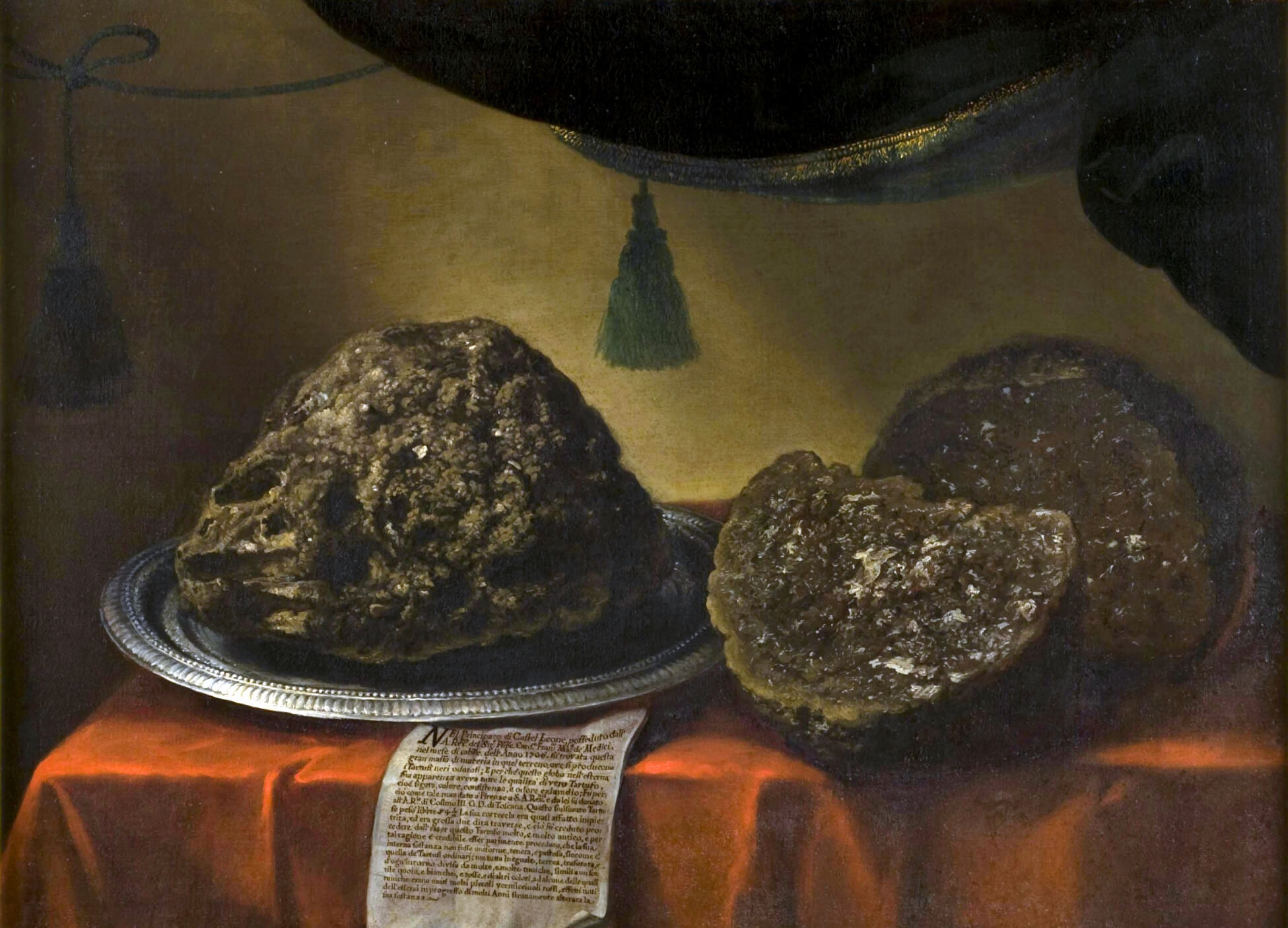
Truffle from Castel Leone Oil on canvas, 89 x 121.5 cm, by Bartolomeo Bimbi, 1706 Museo di Storia Naturale, Villa Medicea di Poggio a Caiano, Prato, Tuscany |
||||||||||
| Tartufo di Castel Leone was commissioned by Grand Duke Cosimo III de’ Medici. After the truffle featured in the painting was discovered, he instructed Bimbi to create a picture of it for his collection at the Villa Medicea. The Duke gave clear instructions on how he wanted the large, ball-shaped truffle depicted. At his request, the truffle was dissected, revealing it was not a single entity but a cluster of smaller truffles bound together by black soil. They were then separated and were found to be very similar in taste, smell, and colour, but they were infested with worms, Following the advice of the Pope's physician, nobody was allowed to consume them. After the painting was completed, the truffles were tossed into the river. The composition illustrates the truffle whole on the left and sliced open on the right. The cartouche in the painting gives this description: 'In the Principality of Castel Leone, owned by His Most Reverend Highness, the Prince Cardinal Francesco Maria de’ Medici, in the month of October of the year 1706, this large mass of material was found in the ground where fragrant black truffles are produced. And because this globe, in its external appearance, had all the qualities of a true truffle—namely its shape, colour, consistency, and even smell—it was therefore sent as such to Florence to His Royal Highness Cosimo III, Grand Duke of Tuscany. This enormous truffle weighed 4 ½ pounds. Its outer layer was almost entirely petrified and was two fingers thick, which was believed to be due to this truffle being very, very ancient. For this reason, it is likewise believed that its internal substance was not uniform, soft, and pasty like that of ordinary truffles, but instead irregular, earthy, perforated, and divided all around by many, many layers resembling thin leather, in white, red, and other colours. Some of these layers were joined by many small red worms, all of which were considered effects of the substance being strangely altered over the course of many years.' |
||||||||||
 |
||||||||||


