
|
|
 |
|
||||||||
Nikolai Astrup (1880–1928) |
||||||||||
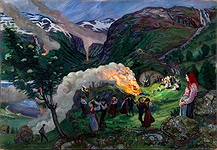
Astrup was a Norwegian painter
and printmaker, primarily known for his evocative portrayals of rural
life in the Jølster region, where he spent much of his life. Born in
Kalvåg on the island of Frøya, Astrup grew up in Ålhus, Jølster, under
the guidance of his father, a parish pastor who initially opposed his
desire to pursue a career in art. Nevertheless, Astrup was determined to
follow his passion and studied at the Royal Academy of Design in
Kristiania (now Oslo), before continuing his studies at the Académie
Julian in Paris. His artwork, characterised by bold lines and vibrant
colours, reflects his deep connection to the Norwegian landscape and its
folklore, often featuring rural scenes that incorporated elements of
Norwegian traditions, legends, and daily life. His use of light and
colour in his paintings exudes a strange, dream-like quality, capturing
the drama of the Norwegian landscape and conveying his love for nature
and rural life. Astrup’s work is often compared to that of Munch due to
its expressive qualities, though his works are generally brighter in
both colour and mood and focus more on his love for nature and rural
life. Despite facing health challenges, he remained dedicated to his
craft, holding exhibitions in cities like Kristiania and Bergen. Though
he is one of Norway’s most renowned artists, Astrup is little known
outside of the country, and his work is considered a significant
contribution to Norwegian modernism, marked by its symbolism and vivid
palette. |
||||||||||
| |
||||||||||



 |
||||||||||
  |
||||||||||


 Art
Art