
|
|
|
|||||||||
 |
||||||||||
 |
||||||||||
 |
||||||||||
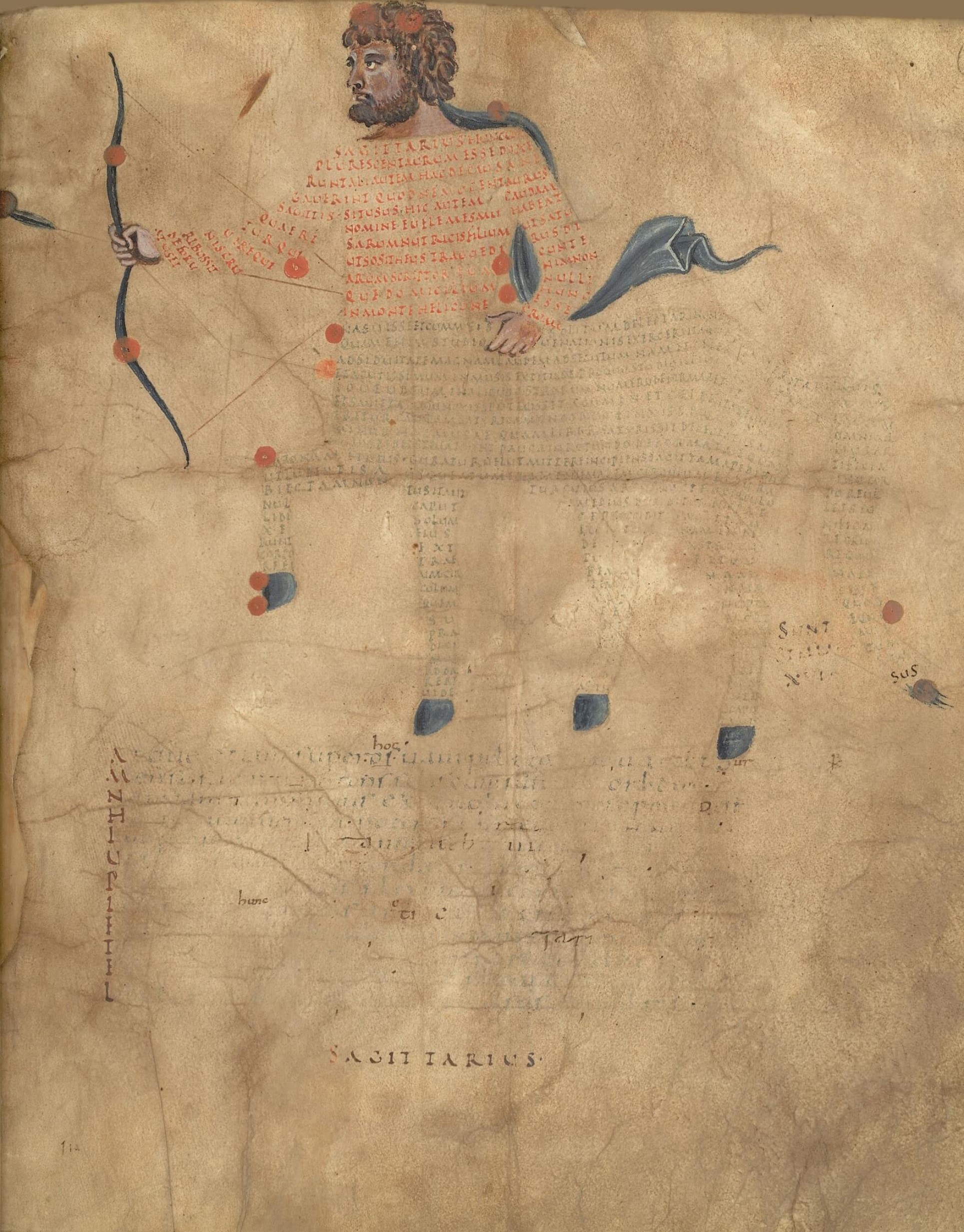
Constellation of Sagittarius
(the Archer) From the Harley Aratus (Harley MS 647), c. 820–40 British Library, London |
||||||||||
| The Harley Aratus, possibly created in Rheims, contains the Phaenomena, a work originally composed by the Greek poet Aratus of Soli at the request of the Macedonian king Antigonus Gonatas (320–239 BC). Aratus was asked to compile a comprehensive handbook on stars and constellations, resulting in the Phaenomena—a poetic account of the astronomical knowledge of his time, presented in hexameter verse. The work became popular, surviving in numerous copies and often accompanied by commentaries, with an early example being a 4th-century papyrus codex containing the poem alongside marginal notes. Cicero also translated it into Latin at the beginning of his career. His translation, known as the Aratea, helped introduce Aratus' work to the Latin-speaking world, although much of it has not survived; only the prologue and a few other sections remain. The Harley Aratus manuscript, part of the British Library’s Harley collection, preserves Cicero’s translation and includes illuminations, which may date from Late Antiquity. This manuscript is notable not only for preserving Cicero’s translation but also for its role in transmitting ancient astronomical knowledge into the medieval period |
||||||||||
  |
||||||||||


