
|
|
|
|||||||||
 |
||||||||||
 |
||||||||||
 |
||||||||||
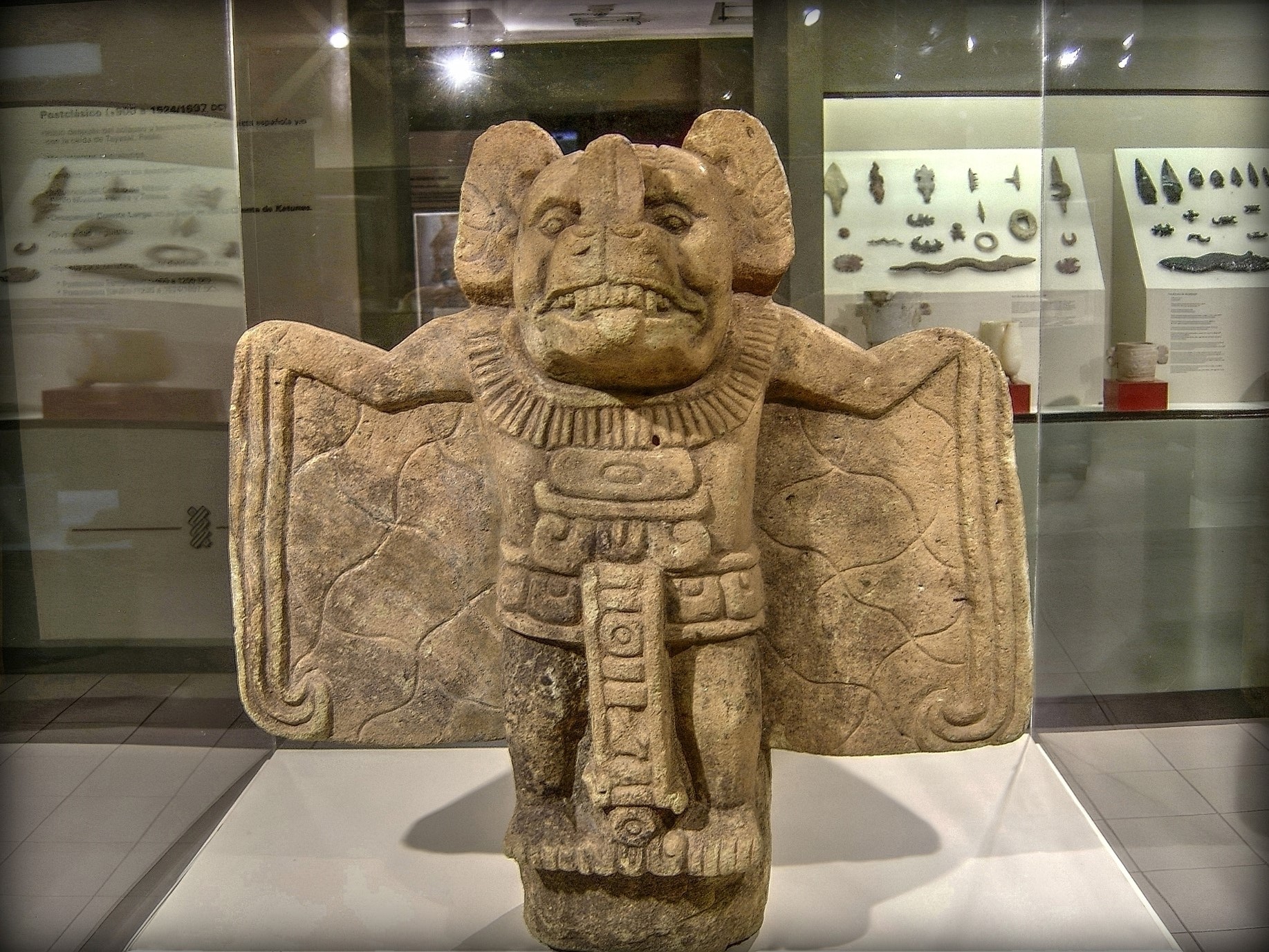
Qaaw’a Sotz’ Limestone, 60 x 57 cm, Mayan, between 600 AD and 900 AD. Museo Popol Vuh, Guatemala City Photograph by M. Octavio Pérez, 2006 |
||||||||||
| Known as Qaaw’a Sotz’, meaning 'Lord Bat' in the Q’eqchi’ Maya language, this sculpture represents a bat-human hybrid figure. In Maya belief systems, bats are closely associated with death, the underworld, and transformation. Although he resembles the Mayan bat deity Camazotz, Qaaw’a Sotz’ is not a deity, but rather a symbolic figure. Such imagery frequently appeared in ceremonial or funerary art, reflecting beliefs about the afterlife and spiritual transformation. It is believed to have originated from the site of Copán, in present-day Honduras, a location known for the richly ornamented façades of its buildings. Beneath the bat’s feet is a short spike, which was likely used to attach the sculpture to a structure. This suggests it functioned as a crenellation — a decorative element placed on the roof of a building, projecting above the façade. Qaaw’a Sotz’ is dressed in a loincloth that reaches its feet and wears a wide necklace with a large pendant in the shape of the SAK sign, which represents the colour white in Mayan writing. Across the top and back of his head runs a band of hieroglyphic symbols, which refer both to the sculpture and to the name — meaning 'first' or 'new youth' — of either its owner or the sculptor. The back is simply smoothed and lacks any detail, indicating that, despite its three-dimensional form, the sculpture was intended to be viewed only from the front. The scukpture dates to the Late Classic Period, a transformative era in Maya history marked by notable population growth in the northern lowlands, along with increased political and cultural interaction between Maya cities, which influenced both religious and artistic expression. |
||||||||||
 |
||||||||||


