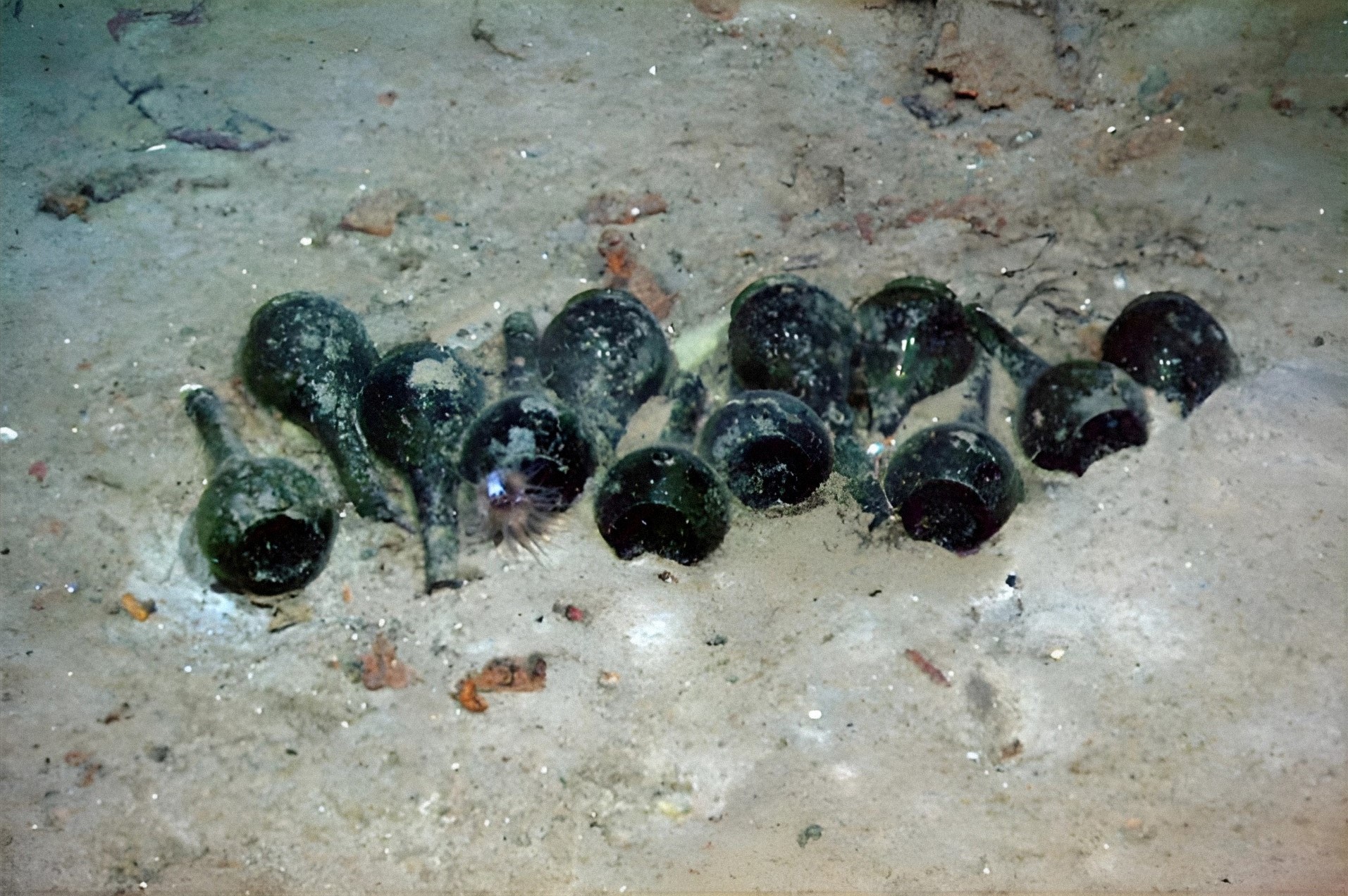
Bottles resting on the
seabed mark the outline of a disintegrated wooden crate that held
them, their glass surfaces still intact despite more than a century
underwater. The image was taken during the RMS Titanic Expedition,
conducted from May 27 to June 12, 2004, which brought together a
team of scientists led by marine explorer Dr Robert Ballard to study
the ongoing deterioration of the famed shipwreck. Nearly two decades
after Ballard first discovered the Titanic’s resting place, he
returned with researchers from NOAA and other institutions to
document the wreck using advanced technology. Aboard the NOAA
Research Vessel Ronald H. Brown, the team spent 11 days at
the site, using remotely operated vehicles to capture
high-definition video and stereoscopic images for a detailed,
non-intrusive survey. In addition to mapping the wreck, the
expedition also focused on studying rusticles—icicle-like formations
created by microbes that consume iron and contribute to the
Titanic’s gradual decay. Although these formations have long been
observed on the wreck, much about the microbes responsible for them
remains unknown.