|


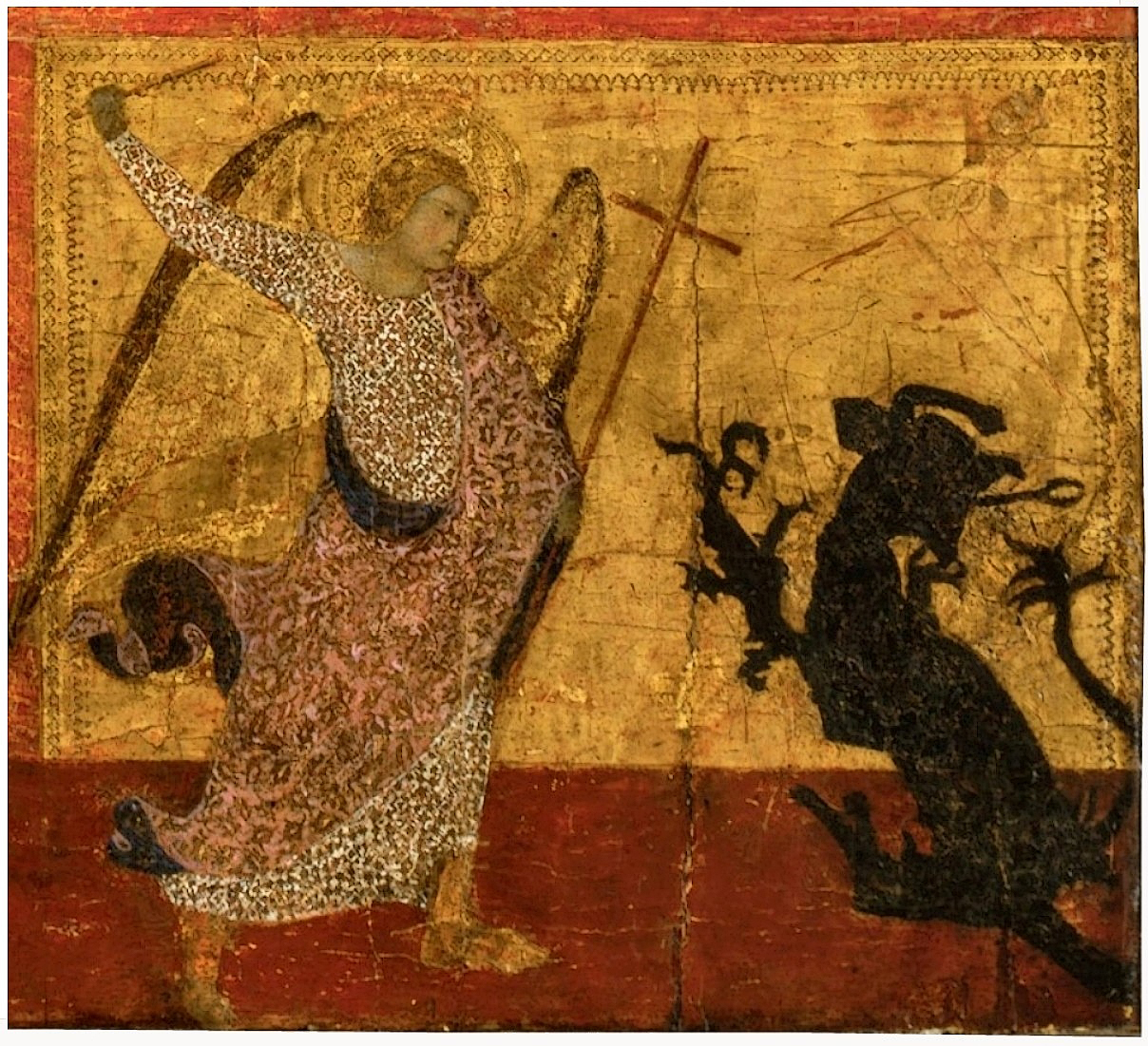
The Mystic Marriage of Saint Catherine (detail of Archangel
Michael)
Tempera on panel, 138.7 x 111.1 cm, attributed to Barna da Siena, c. 1340
Museum of Fine Arts Boston
Controversially attributed to Barna da Siena (it has also been
attributed to Tederigo Memmi)
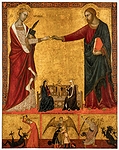
The panel, attributed to Barna da Siena, and by others, to Tederigo
Memmi, symbolically portrays Jesus marrying Saint Catherine, with Jesus
placing a ring on her fourth finger as a representation of their marital
bond. Below the main scene, Mary, Saint Anne, and the infant Jesus are
depicted, representing the bridegroom’s lineage. The large size of the
panel suggests it was created for a church or convent rather than for
private devotion, likely for a setting dedicated to Saint Catherine. The
marriage scene, with its symbolic nuptial imagery, may also commemorate
a real-life peace agreement or marriage, with the panel's commissioner
potentially celebrating the resolution of conflict. This idea is
visually echoed in the predella beneath the marriage scene, where two
former adversaries, having discarded their weapons, embrace and exchange
the kiss of peace under the protective wings of an angel. The angel's
embrace guides the reconciliation, creating a sacred space for the act.
Flanking the peace scene are two smaller images: on the left, Saint
Margaret subdues Beelzebub with a mallet, and on the right, the
Archangel Michael slays a dragon with a cross, both representing the
triumph of good over evil. The panels on either side suggest the victory
of peace over chaos. The central image, in contrast, radiates calm and
order, with the Archangel Michael’s serene stance and protective wings
symbolising divine peace. The depiction of Arico di Neri Arighetti,
commissioned to memorialise the end of a feud, is confirmed by the
inscription and the family’s coats of arms in the upper corners. The
composition, inspired by Duccio’s style, emphasises the psychological
depth of the peaceful transition from discord to harmony, with the
angel’s wings framing the scene as a symbol of divine mercy and
protection.
|
|

|
Provenance
 Commissioned
by Arigo di Neri Arighetti, c. 1340 Commissioned
by Arigo di Neri Arighetti, c. 1340
Robert
Macpherson, Rome, 1858
William
Blundell Spence, London, 1859
Possibly
in the collection of Alexander Barker (†1873)
Sold
to the uncle of Algernon Sartoris, London
Algernon
Sartoris (1877–1907), Paris and London
Gimpel
and Wildenstein, Paris and New York
Museum
of Fine Arts Boston accession, 1915
Source: Museum of Fine Arts Boston, 2023 |


