
|
|
|
|||||||||
 |
||||||||||
| (4355) | ||||||||||
| Johann
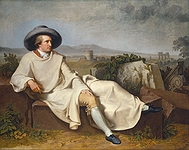
Wolfgang von Goethe (1749–1832) Biographical Ennobled 1782 (Holy Roman Empire) Chancellor of the Exchequer of the Duchy of Weimar 1782–85 Member of the Privy Council of the Duke of Saxe-Weimar 1779, 1804 Goethe was a literary giant whose work spanned poetry, drama, science, and public service, all deeply connected to the emotional and philosophical currents of his personal life. Raised in an intellectually stimulating household that prioritised classical education and artistic development, he was exposed early to literature, languages, and art, which formed the foundation of his broad intellectual interests. His upbringing, influenced by Enlightenment ideals and humanist values, shaped his natural curiosity and fostered a lifelong commitment to self-education across many fields. His early success with The Sorrows of Young Werther brought him widespread fame and encapsulated the ethos of the Sturm und Drang movement, a German literary movement focused on intense emotion, individualism, and a rejection of Enlightenment rationalism, capturing his own youthful anguish in a way that resonated across Europe. Yet, as his work evolved, Goethe consciously moved away from emotional excess towards a more restrained, classical approach, exemplified in Iphigenia in Tauris and his monumental Faust, which blended mythology, theology, and philosophy into a profound reflection on human striving and moral ambiguity. His interests were not confined to literature; he was also deeply involved in scientific research, exploring optics, botany, and anatomy, even challenging Newton’s theories on light with his own studies on colour. His approach was grounded in empirical observation and careful analysis. Goethe's personal relationships played a significant role in shaping both his work and his worldview. Early infatuations, such as with Käthchen Schönkopf and Lili Schönemann, inspired many of his poems and plays, while his long-term, unconventional partnership with Christiane Vulpius, whom he eventually married, challenged societal norms and reflected his resistance to bourgeois expectations. His emotional journey included periods of spiritual crisis, such as a brief engagement with evangelical Christianity and a fascination with alchemy, which added layers of complexity to his writing. In Weimar, as a statesman, Goethe balanced administrative duties with cultural leadership, shaping the city’s intellectual landscape while continuing to write, study, and correspond with leading thinkers of his time. His friendship with Friedrich Schiller was particularly significant, spurring a period of intense collaboration that played a crucial role in defining German classicism. Goethe’s life was a constant negotiation between passion and discipline, intuition and reason, private longing and public duty, a balance that made him not just a central figure in German literature but also a symbol of the Romantic movement’s broad influence across all spheres of human endeavour. Place of birth: Frankfurt am Main Place of marriage: Weimar Place of death: Weimar Place of burial: ducal chapel, Weimar Son of Johann Caspar Goethe and Catharina Elisabeth Textor, he had issue by Christiane Vulpius, and later married her in 1806. |
||||||||||
| |
||||||||||


 |
||||||||||
| |
||||||||||
 |
||||||||||


