|


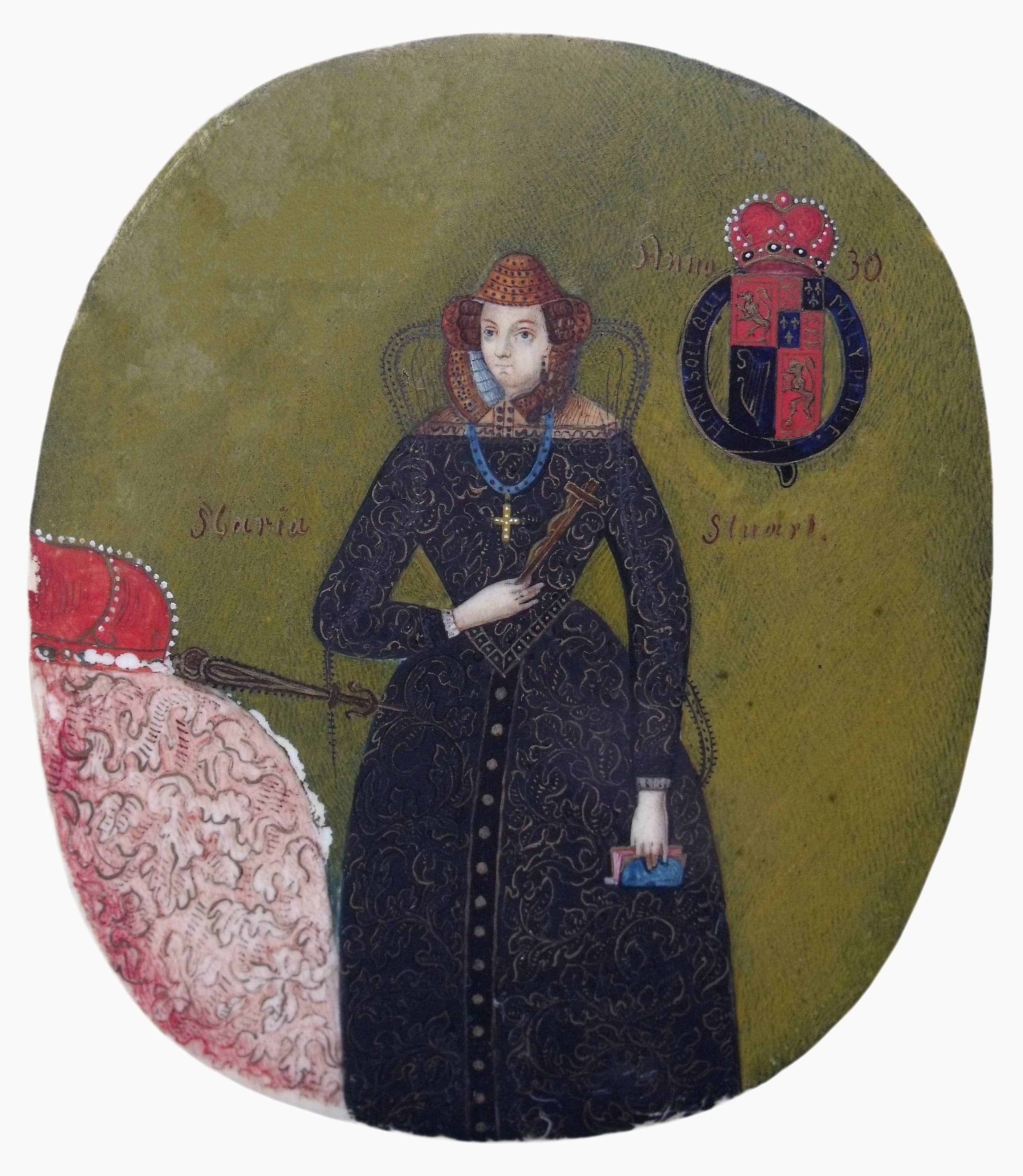
Mary, Queen of Scots
Watercolour of ivory, 9.3 x 11 cm, anonymous, 18th century
Private collection
Mary wears a conical reddish-brown cap with a domed point and a broad
base, possibly woven or stitched. Her hair is puffed out at the sides.
She wears a collar in a similar colour to her hat, a fine black lace
fabric across her upper chest, and a black gown richly embroidered
with gold, fitted closely at the waist. In her right hand, she holds
a crucifix; in her left, a small book, possibly for devotion. Delicate
lace cuffs adorn her wrists. A blue necklace falls to her chest, with
a golden cross pendant hanging below. To her right, a richly draped
table holds a crown and sceptre, while to her left, a crown appears
above a shield encircled by the Garter. Two gold and red-lettered
inscriptions read 'Maria Stuart' and 'Anno 30', marking the year as
1572, when she was 30. The shield beneath the crown, encircled by
the Garter, contains the Lion of Scotland twice, the Harp of Ireland,
and in the fourth quarter, the Lilies of France and the Leopards of
England. This representation appears to emphasise Mary’s identity
as a Catholic captive, while the inclusion of English arms underscores
her controversial claim to the English throne and her status as the
legitimate sovereign. This miniature was clearly designed to appeal
to a Catholic supporter. Other, very similar examples survive, likely
serving the same political and religious purpose: affirming Mary’s
claim as the rightful Catholic Queen. Stylistically, they follow the
approach of Nicholas Hilliard and his contemporaries and may have
been copied from a now-lost 16th century miniature portrait of Mary,
later reproduced for English Catholic Jacobites in the eighteenth
century. In 1571–1572, Catholics still regarded Mary as 'the good
Queen who is now a prisoner, in whom the present right of the crown
rests', making it plausible that a portrait or miniature presenting
Mary as a claimant to the English throne was created at the time to
comfort her English Catholic followers.

 |
|

|