|

|
UC Picture Gallery
 |
|
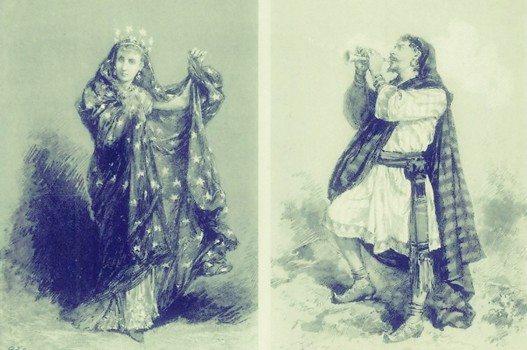
The Magic Flute
The Magic Flute (Die Zauberflöte) a Singspiel
opera in two acts, was composed by Wolfgang Amadeus Mozart
with a libretto by Emanuel Schikaneder, based mainly on
the tale 'Lulu' or 'The Magic Flute', from Christoph Martin
Wieland's Dschinnistan of 1789. It follows the
story of Prince Tamino who, after being saved by the Queen
of the Night's attendants from a serpent, embarks on a quest
to rescue her daughter, Pamina, from the clutches of the
high priest Sarastro. Alongside the bird-catcher Papageno,
Tamino undergoes trials of wisdom, courage, and virtue to
prove himself worthy of Pamina's love. The narrative unfolds
through a combination of spoken dialogue and sung passages,
characteristic of the Singspiel genre. Mozart's score is
a testament to his compositional genius, featuring intricate
ensemble pieces, emotive arias, and rich orchestration.
Symbolism pervades the opera, with key signatures representing
characters and themes, adding depth to the narrative. Harmonically,
Mozart explores a wide spectrum of tonalities and employs
chromaticism to evoke the fantastical atmosphere of the
opera. His orchestration is both innovative and refined,
with the orchestra playing a pivotal role in conveying the
drama and dynamics of the story. The opera premiered at
the Wiedener Theater in Vienna on the 30th of September
1791.
|
| |
The
Opera |
| Characters |
|
Name |
Description |
Voice
Type |
Premiere Cast |
Sarastro |
Priest of Isis and Osiris |
bass |
Franz Xaver Gerl |
Queen of the Night |
|
soprano |
Josepha Hofer |
Pamina |
daughter of the Queen of the Night |
soprano |
Anna Gottlieb |
Tamino |
a Javanese prince |
tenor |
Benedikt Schack |
Papageno |
a birdcatcher, employed by the Queen of the Night |
baritone |
Emanuel Schikaneder |
Old woman, later, Papagena |
|
soprano |
Barbara Gerl |
Sprecher |
|
bass |
'Herr Winter' |
Three priests |
|
·
first priest - tenor
· second priest - bass
· third priest - bass |
·
Johann Michael Kistler
· Urban Schikaneder
· 'Herr Moll' |
Monostatos |
a Moor, overseer of the Temple |
tenor |
Johann Joseph Nouseul |
Three ladies |
attendants of the Queen |
·
first Lady - soprano
· second Lady - soprano/ mezzo-soprano
· third lady - soprano/ contralto |
·
'Mlle Klöpfer
· 'Mlle Hofmann'
· Elisabeth Schack |
Three boys (the Spirits) |
|
sopranos |
·
Anna Schikaneder
· Anselm Handelgruber
· Franz Anton Maurer |
Two armoured men |
|
·
first armoured man - tenor second · armoured man -
bass |
·
Johann Michael Kistler
· 'Herr Moll' |
Three slaves |
|
spoken |
·
Carl Ludwig Gieseke
· Wilhelm Frasel
· 'Herr Starke' |
|
Setting |
Ancient Egypt |
| Acts |
1 |
Overture |
Act
I |
Role |
2 |
No. 1: Introduction |
'Zu Hülfe! Zu Hülfe!' |
Tamino, three ladies |
3 |
Dialogue |
'Wo bin ich?'
|
Tamino |
4 |
No. 2: Aria |
'Der Vogelfänger bin ich ja'
|
Papageno |
5 |
Dialogue |
'He da!'
|
Tamino, Papageno, three ladies |
6 |
No. 3: Aria |
'Dies Bildnis ist bezanbernd schön'
|
Tamino |
7 |
Dialogue |
'Schöner Jüngling!'
|
three ladies, Tamino |
8 |
Dialogue |
'Ihr Götter, was ist das?'
|
Tamino, three ladies |
9 |
No. 4: Recitative and Aria |
'O zittre nicht' |
Queen of the Night |
10 |
Dialogue |
'Ist es auch Wirklichkeit'
|
Tamino |
11 |
No. 5: Quintet |
'Hm, hm, hm, hm, hm!' |
Papageno, Tamino, three ladies |
12 |
No. 6: Trio |
'Du feines Täubchen, nur herein!'
|
Monostatos, Pamina, Papageno |
13 |
Dialogue |
'Bin ich nicht ein Narr'
|
Pamina, Papageno |
14 |
No. 7: Duet |
'Bei Männern, welche Liebe fühlen'
|
Pamina, Papageno |
No. 8: Finale I |
15 |
|
'Zum Ziele führt dich diese Bahn'
|
three boys, Tamino |
16 |
|
'Die Weisheitslehre dieser Knaben'
|
Tamino, sprecher, chorus |
17 |
|
'Wo willst du, kühner Fremdling, hin?'
|
sprecher, Tamino |
18 |
|
'Wie stark ist nicht dein Zauberton'
|
Tamino |
19 |
|
'Schnelle Füße, rascher Mut'
|
Pamina, Papageno, Monostatos, chorus |
20 |
|
'Es lebe Sarastro, Sarastro lebe'
|
chorus, Papageno, Pamina |
21 |
|
'Herr, ich bin zwar Verbrecherin'
|
Pamina, Sarastro, Monostatos, chorus |
22 |
|
'Wenn Tugend und Gerechtigkeit'
|
chorus |
Act
II |
Role |
1 |
No. 9 |
Marsch der Priester |
|
2 |
Dialogue |
'Ihr, Diener der großen Götter'
|
Sarastro, two priests |
3 |
No. 9a |
Der dreimalige Akkord
|
|
4 |
Dialogue |
'Sarastro dankt euch'
|
Sarastro, second priest |
5 |
No. 10: Aria with Chorus |
'O Isis und Osiris' |
Sarastro, chorus |
6 |
Dialogue |
'Eine schreckliche Nacht'
|
Tamino, Papageno, two priests |
7 |
No. 11: Duet |
'Bewahret euch vor Weibertücken' |
two priests |
8 |
Dialogue |
'He, Lichter her!'
|
Papageno, Tamino |
9 |
No. 12: Quintet |
'Wie, wie, wie?' |
three ladies, Papageno, Tamino, chorus |
10 |
Dialogue |
'Jüngling! Dein standhaft männliches Betragen'
|
two priests, Papageno |
11 |
Dialogue |
'Ha, da find’ ich ja die spröde Schöne!'
|
Monostatos |
12 |
No. 13: Aria |
'Alles fühlt der Liebe Freuden'
|
Queen of the Night |
13 |
Dialogue |
'Zurück!'
|
Queen of the Night, Pamina, Monostatos |
14 |
No. 14: Aria |
'Der Hölle Rache kocht in meinem Herzen'
|
Queen of the Night |
15 |
Dialogue |
'Morden soll ich?'
|
Pamina, Monostatos |
16 |
No. 15: Aria |
'In diesen heil'gen Hallen'
|
Sarastro |
17 |
Dialogue |
'Hier seid ihr euch beide allein überlassen'
|
two priests, Papageno, Tamino |
18 |
Dialogue |
'Prost'
|
Papageno, Papagena |
19 |
No. 16: Trio |
'Seid uns zum zweitenmal willkommen'
|
three boys |
20 |
Dialogue |
'Tamino, wollen wir nicht speisen?'
|
Papageno, Pamina |
21 |
No. 17: Aria |
'Ach, ich fühl’s'
|
Pamina |
22 |
Dialogue |
'Nicht wahr, Tamino'
|
Papageno |
23 |
No 18: Chorus |
'O Isis und Osiris, welche Wonne'
|
chorus of priests |
24 |
Dialogue |
'Prinz, dein Betragen'
|
Sarastro, Pamina |
25 |
No. 19: Trio |
'Soll ich dich, Teurer, nicht mehr seh’n?'
|
Pamina, Sarastro, Tamino |
26 |
Dialogue |
'Tamino! Tamino!'
|
Papageno, a voice, two priests |
27 |
No. 20: Aria |
'Ein Mädchen oder Weibchen'
|
Papageno |
28 |
Dialogue |
'Da bin ich schon, mein Engel!'
|
Papagena, Papageno, second priest |
No. 21: Finale II |
29 |
|
'Bald prangt, den Morgen zu verkünden'
|
three boys, Pamina |
30 |
|
'Der, welcher wandert diese Straße voll
Beschwerden'
|
armoured men, Tamino, Pamina |
31 |
|
'Tamino mein! O welch ein Glück'
|
Pamina, Tamino, armoured men |
32 |
|
'Wir wandelten durch Feuersgluten'
|
Papageno, Tamino, chorus |
33 |
|
'Papagena! Papagena!'
|
Papageno, three boys |
34 |
|
'Pa-pa-pa-pa-pa-pa-Papagena!'
|
Papageno, Papagena |
35 |
|
'Nur stille, stille, stille!' - 'Die Strahlen der Sonne'
|
Monostatos, Queen of the Night, three ladies, Sarastro, chorus |
 |
Sources:
1. Peter Branscombe. W.A. Mozart, die Zauberflöte.
Cambridge: Cambridge University Press, 1991.
2. Wolfgang Amadeus Mozart, Die Zauberflöte
[CD]. Ramey, Studer, Te Kanawa, Araiza, Bär et al, Academy
of St Martin in the Fields, conducted by Sir Neville Marriner,
recorded 1989, Philips, 1990.
|
|
|
|