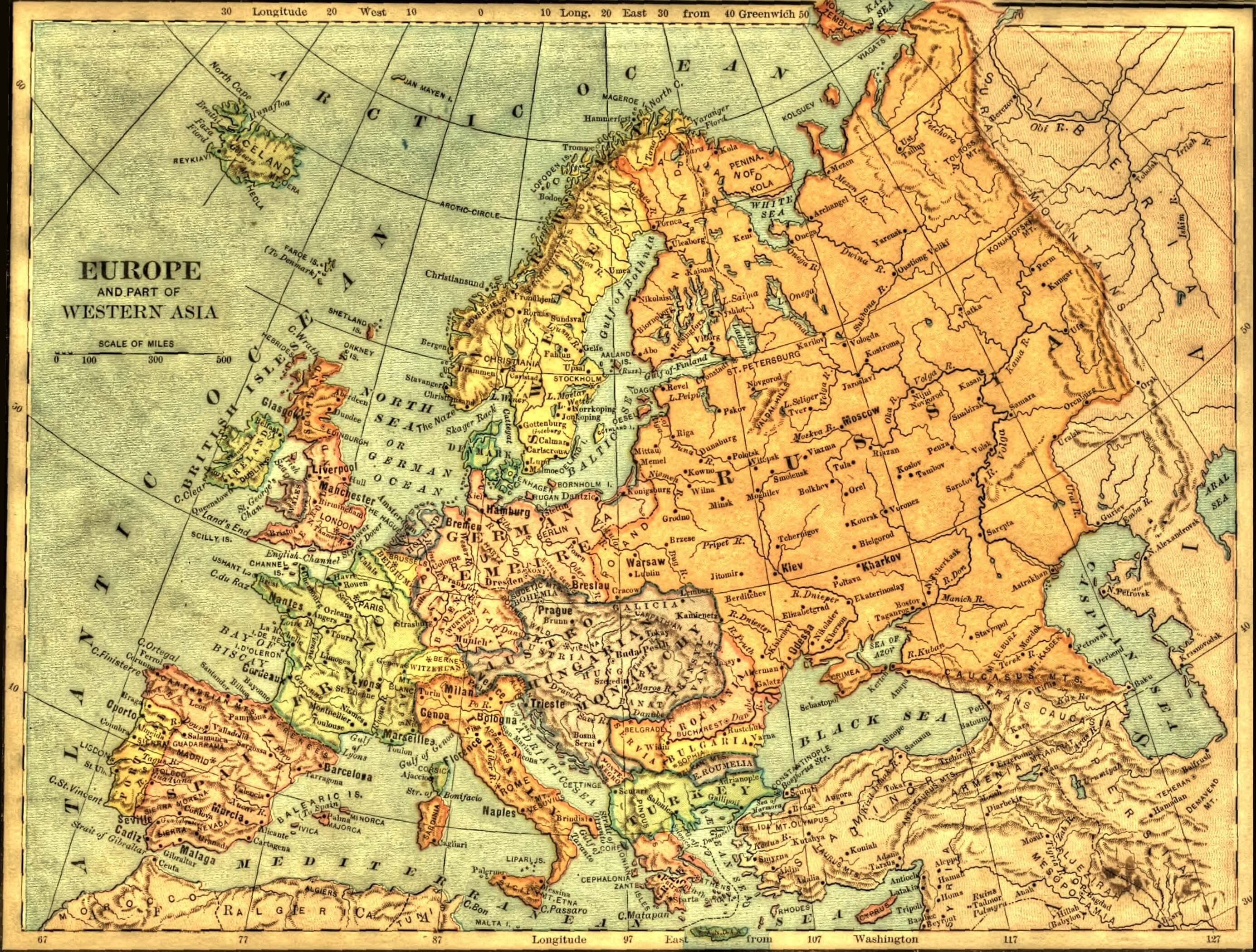
Europe and part of
Western Asia, 1883
Europe is bounded on the north by the Arctic Ocean; on the west
by the Atlantic Ocean; on the south by the Mediterranean Sea, the
Sea of Marmora, the Black Sea, and Mount Caucasus; and on the east
by the Caspian Sea, the Ural River, and Ural Mountains, which
separate it from Asia. Although the smallest of the great divisions
of the earth in extent, it is second in population, and by far the
most important in power and influence, as well as the most advanced
in learning, arts, and manufactures. The surface of Europe is
divided by mountain ranges into a north-west and south-east slope,
as all the great rivers on the continent flow in these directions.
The north and east, with the exception of Norway and Sweden,
consists of a vast plain, with occasional small elevations, and
comprises about two-thirds of the whole surface, extending from
Holland to the Ural Mountains, and including all Russia; in the
south and west it is mountainous or hilly. The countries of Europe
are: Great Britain and Ireland, Norway and Sweden, Russia, Denmark,
Holland, Belgium, France, Spain, Portugal, Germany, Austro-Hungary,
Italy, Switzerland, Turkey in Europe, and Greece.
—
Modern School Geography and Atlas, 1880