
|
|
|
|||||||||
 |
||||||||||
| Nicolas Lancret (1690–1743) | ||||||||||
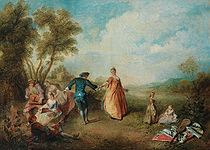
| Lancret, a French painter known for his fêtes galantes, was born in Paris into a family with a respected history in the Shoemakers' Guild. His early years were marked by loss, as his father died while he was still young. He began training in drawing with his uncle, an engraver, before moving to Pierre d’Ulin’s studio and later studying under Claude Gillot, where he met Jean-Antoine Watteau. Lancret became captivated by Watteau's style and devoted himself to it. His work gained attention after exhibiting two pieces mistakenly attributed to Watteau, causing a brief fallout with the master. He earned the support of collector Pierre de Crozat and other art patrons. Lancret was a committed artist, often sketching in the countryside during summer and attending the Academy's life-school in winter. His first notable works, Le bal champêtre and Une danse dans un bosquet, appeared in 1714, revealing his distinct style. In 1719, he joined the Academy as a painter of fêtes galantes and became a regular at the Opera and La Comédie Française, often depicting dancers such as La Camargo and La Salle. His charm and sociable nature helped him gain recognition. In 1735, he was elected Conseiller of the Academy and later presented to Louis XV, who commissioned six works for Versailles. Lancret married in 1740, but his marriage was short-lived, and he died in Paris. While often regarded as a pupil of Watteau, his work lacks the warmth and grace of his mentor but excels in truthfulness, naturalness, and skilful execution. His art is marked by graceful movement and a distinctive silvery-grey tone. | ||||||||||
| |
||||||||||
 
  |
||||||||||
|
|
||||||||||
| |
||||||||||
  |
||||||||||


 Art
Art