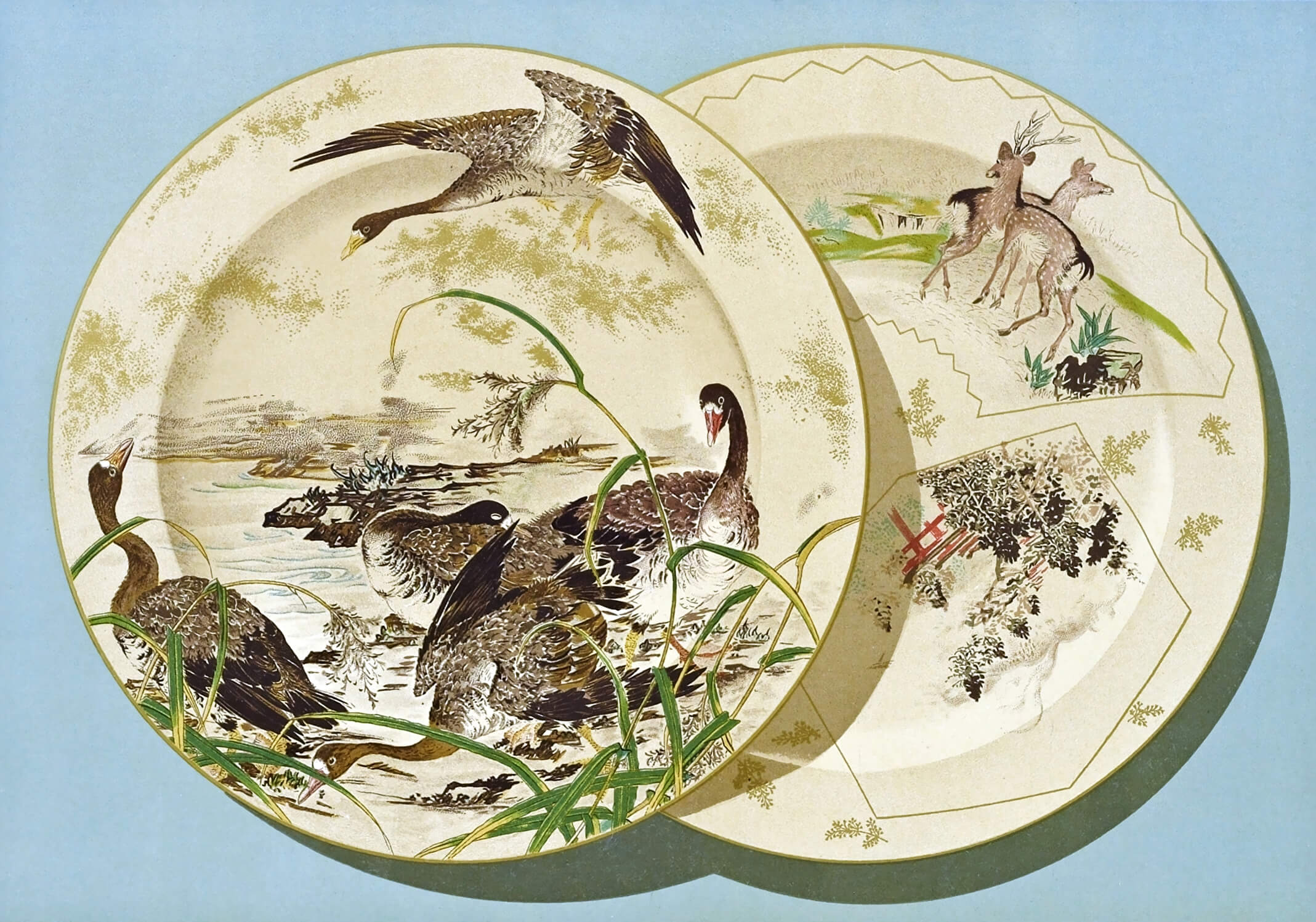
   Kyoto ware: two dishes Left — Large dish of Modern faience, manufactured by Tai-zan of Kyoto. The pâte is of a rich cream tint, of fine quality, and covered with a thin bright glaze, crackled. The masterly manner in which the decoration of this piece is executed, and the artistic treatment it displays, place it amongst the most interesting and remarkable works which have come from Japan. It clearly proved that the native artists had not yet lost their cunning or become unworthy of their ancestors of two hundred years ago. In truthfulness to nature, in grouping, in variety of action, in artistic manipulation, and in colouring, it would be difficult to find a work of Japanese bird drawing superior to this. The piece was originally sent by the Japanese Commissioners to the London International Exhibition of 1874, before passing to another owner. Diameter: 25 inches. Right — Large dish of Tai-zan faience; resembling, so far as material and workmanship are concerned, the previous specimen. The decoration, however, is widely different in conception, assuming the quainter and more characteristic style adopted by the decorative artists of Japan. It is covered with three medallions, simply divided from the ground by gold lines, and filled in with different subjects. The one on the upper part of the plate, consisting of two deer beside a waterfall, is drawn, in all probability, by the same artist that drew the wild geese on the accompanying dish. The lower medallion contains a temple avenue, with a row of tons, or sacred gateways, sketched in the most free and artistic manner. The ground of the dish is simply powdered with small tufts of seaweed in gold. Diameter: 18 inches. Lithograph, by Dulong, published 1875.
|
|


