|
|


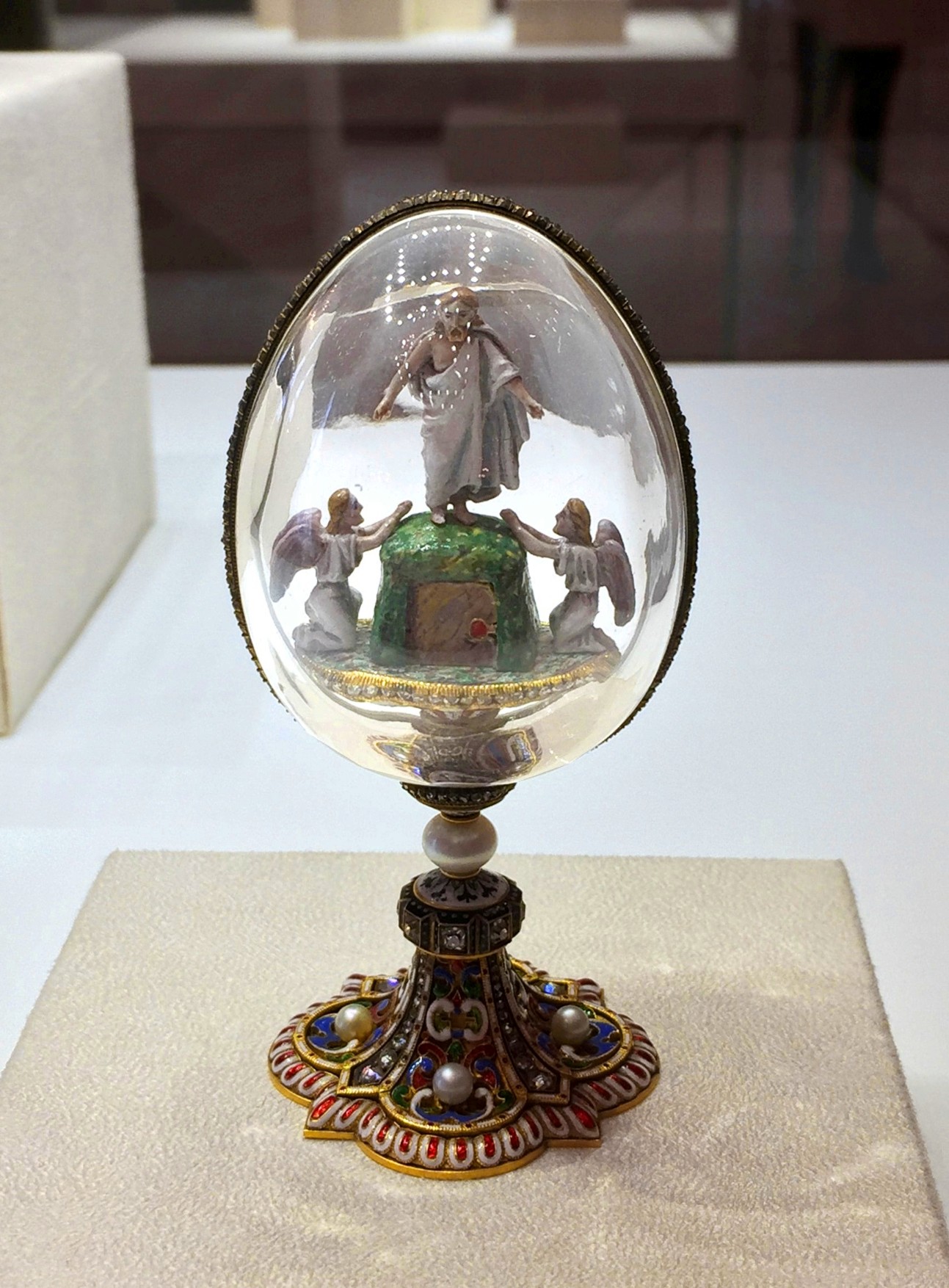
Resurrection
Egg
Gold, diamonds, pearls, rock crystal; h.
9.8 cm
by House of Fabergé, and Mikhail Perkhin, 1884–98
Fabergé Museum, St Petersburg
After a 2017 photograph by
Testus
The Resurrection Egg, or Transformation Egg, is made from a single block of translucent rock crystal, and
is decorated
with yellow gold, rose-cut diamonds, pearls, and red, green,
white, blue, and black enamel. It is designed in the form of a monstrance with influences from
the Italian Renaissance. The egg features a central scene of Christ
standing above a tomb flanked by two kneeling angels with white enamelled
robes on an oval raised base bordered with diamonds. The entire scene is
encased within a rock crystal egg-shaped shell, with a vertical band
of diamonds and a domed quatrefoil foot adorned with multicoloured
Renaissance-style scrolls and diamond-set ribbons, set with four pearls.
The piece is marked with the Cyrillic initials of Fabergé and an assay
mark indicating its 14-karat gold content. This egg does not open,
and it has been theorised that it is in fact the surprise belonging
to the Imperial
Renaissance
Egg.
|
|

|
Provenance
 Empress
Maria Feodorovna, after 1884 Empress
Maria Feodorovna, after 1884
A
London dealer, 1922
R.
Suenson-Taylor, UK, 1934
Alfred
Suenson-Taylor, Lord Grantchester, 1955
Mamie
Suenson-Taylor, Lady Grantchester, 1962–76
A La Vieille Russie, NY, 1976–78
Forbes
Magazine Collection, NY, 1978–2004
Vekselberg
Foundation, 2004
Fabergé
Museum, St Petersburg
Source: Mieks Fabergé Eggs site, 2023.
|