|
|
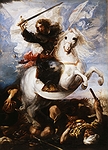
Juan Carreño de Miranda (1614–1685) A historical, portrait, and
fresco painter of the Baroque period, Carreño was born at Aviles in
Asturias. His father, who was of a noble family, perceiving that he
showed the force of natural genius in an extraordinary degree, placed
him in the school of Pedro de las Cuevas at Madrid. Under this master,
Carreño made rapid progress, and improved still more with Bartolome
Roman, who made him a fine colourist. He improved himself in design
and colouring by studying the works of Velazquez and Van Dyck. At twenty-years
of age he painted the picture for the Cloister of Maria de Aragon; also
those for the Convent del Rosario; and he was now considered as one
of the most eminent artists of the time. Velasquez gave him employment
in the king's palace, and his first work was a fresco representing the
fable of Vulcan, and another of Pandora and Epimetheus, which he was
prevented, by illness, from finishing. He was court painter to Philip
V and Charles II. His colouring was in tenderness and suavity, perhaps
superior to that of any painter of his country except Murillo. He also
executed several etchings. He died at Madrid. |
|
||||||
| |
||||||||
|