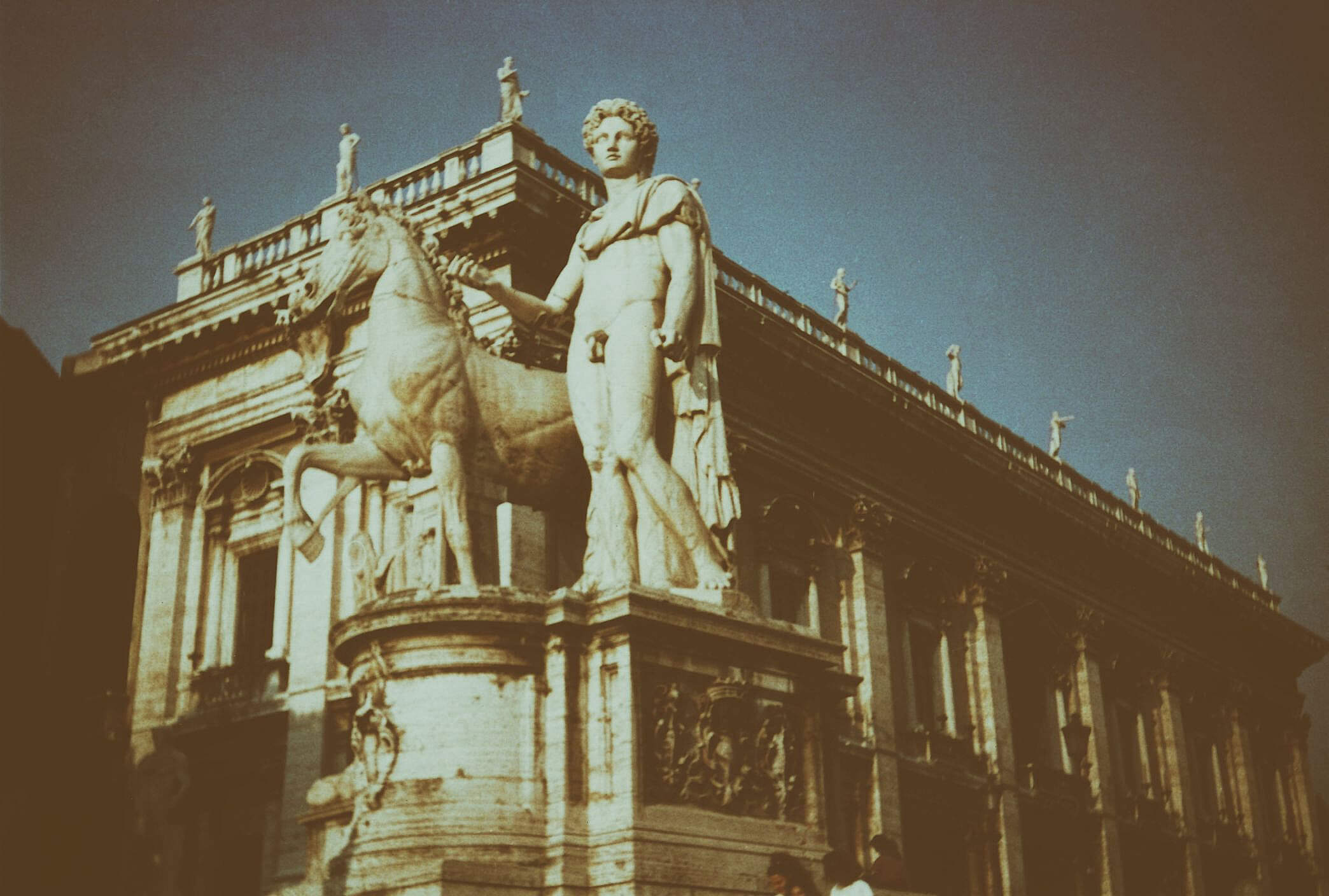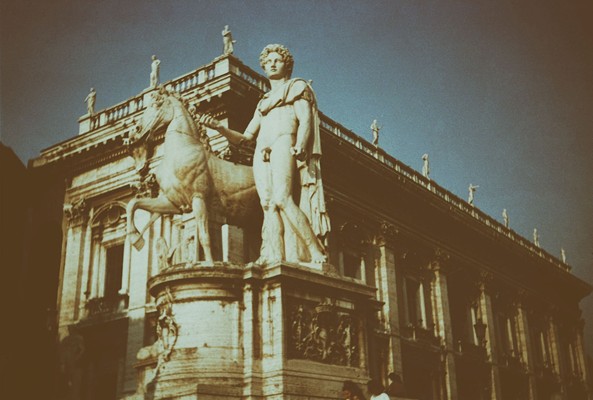
Statue of Castor, Piazza del Campidoglio, Capitoline Hill, Rome
At the summit of the Cordonata, placed on pedestals in a position
corresponding with the lionesses at the bottom, are a pair of
sculptured groups of Castor and Pollux, each represented with a
horse, as they are said to have appeared to the Romans while
watering their perspiring steeds at the fountain of Juturna, at the
base of the Palatine, whither they brought tidings of the victory
over the Tarquins at the Lake Regillus. Both groups were discovered
about the year 1580, in the reign of Pius IV, in the square of the
Jews' synagogue in the Ghetto, not very far from the spot where the
temple erected to Castor and Pollux, in consequence of the above
apparition, is supposed to have been situated; and both were removed
hither by Gregory XIII about twenty years after the discovery. The
statues are of very ordinary execution; and were it not that all are
of the same description of Pentelic marble, one would think the men
and horses were never intended to stand together—such is the
disproportion of the colossal youths to the small size of the
horses, which would seem thoroughly incapable of bearing such
riders. At any rate, the objects are by 110 means calculated for
their prominent position, and were evidently intended by the
sculptor to be placed their backs to the wall; and the backs of the
men are unfinished accordingly, composed of rough blocks of marble,
of which the gaping joints are clumsily held together by iron clamps
or rivets.
— Rome. A Tour
of Many Days. Sir George Head, 1849