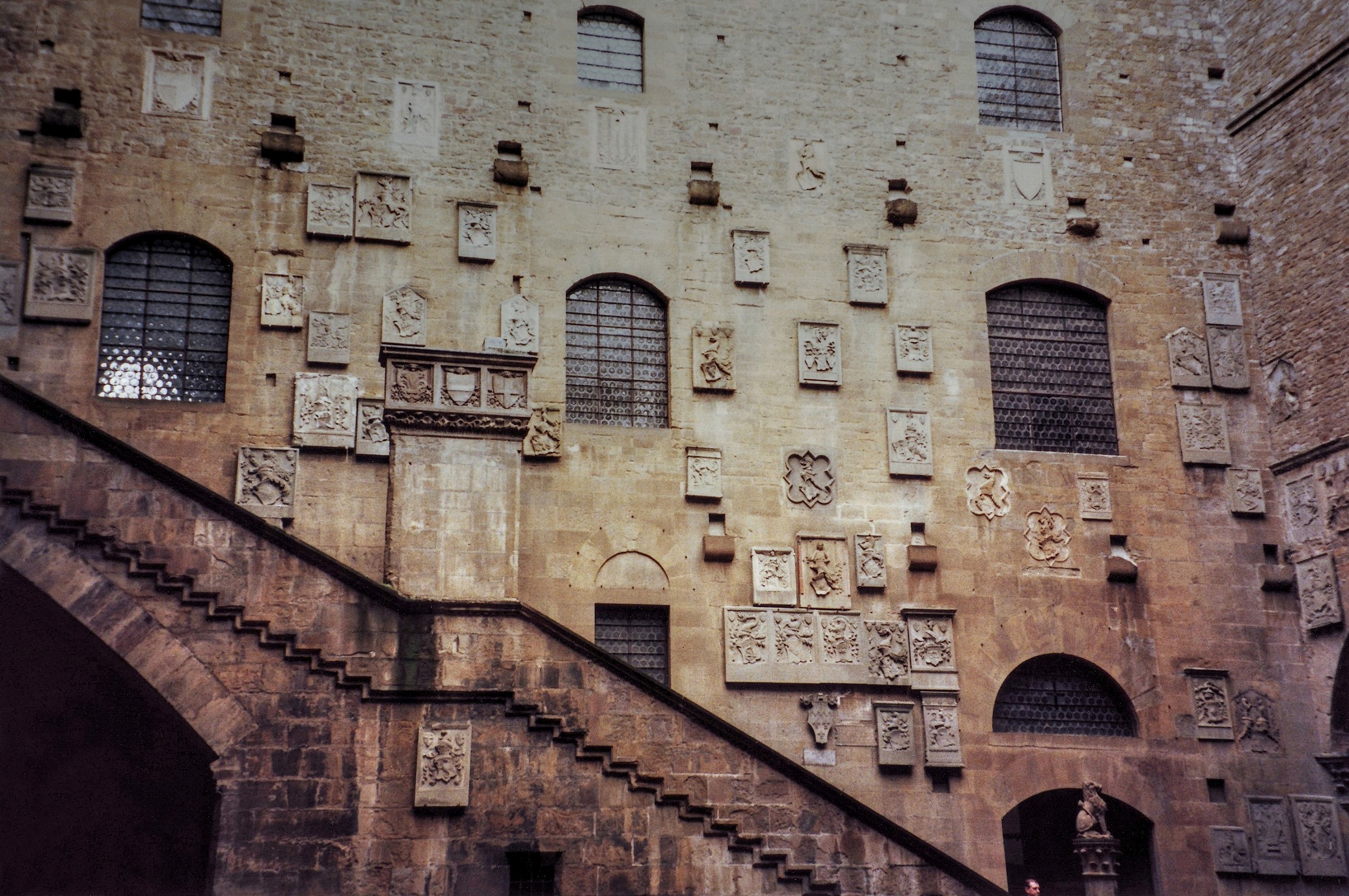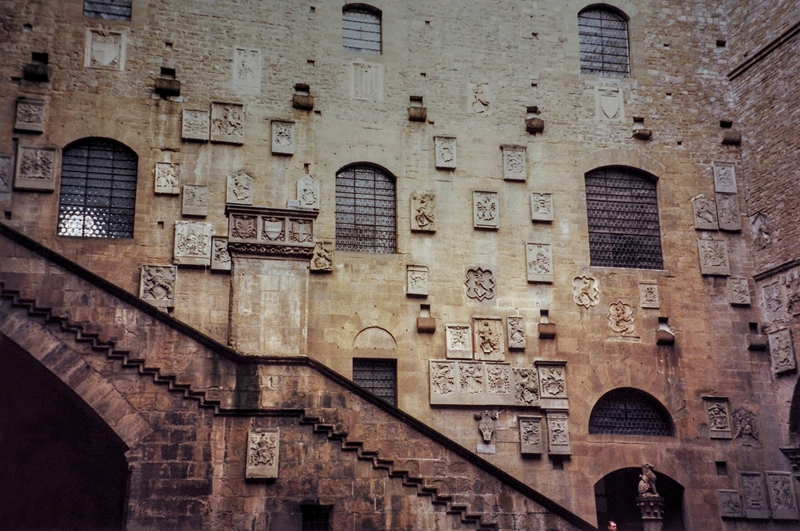
Courtyard of the Palazzo del Bargello
Photograph by MCN, 1995
The Bargello, located in the heart of Florence, is a landmark of
significant historical and architectural importance. Constructed in
1255, it was initially designed by Lapo Tedesco, with contributions
later attributed to Arnolfo di Cambio, one of the key architects of
the Florentine Gothic style. Originally built as the Palazzo del
Capitano del Popolo, it served as the headquarters for the Captain
of the People, an official tasked with safeguarding the interests of
the city’s citizens during Florence’s turbulent medieval period. Its
design, characterised by crenellated walls, a towering campanile,
and a large central courtyard, reflected the austere and defensive
nature of civic buildings of the time. By the mid-16th century, the
building underwent a significant transformation, becoming the
residence of the Bargello, the city’s chief of police, from which it
takes its name. It also operated as Florence’s main prison for
centuries, with its courtyard witnessing numerous judicial
proceedings and public executions, adding a darker chapter to its
history. In 1865, during the unification of Italy, the Bargello was
repurposed as a national museum, becoming one of the first
institutions dedicated to preserving Italy’s artistic heritage. The
Bargello Museum is now celebrated for its extraordinary collection
of Renaissance sculpture, housing masterpieces by renowned artists
such as Michelangelo, Donatello, Verrocchio, and Cellini. The museum
also holds significant collections of decorative arts, including
ceramics, textiles, ivory, and weaponry, providing a broader view of
the craftsmanship of the era. The building itself remains an
outstanding example of medieval Florentine architecture, offering
visitors a glimpse into the city's civic and judicial past while
highlighting its enduring cultural legacy.
|
 |